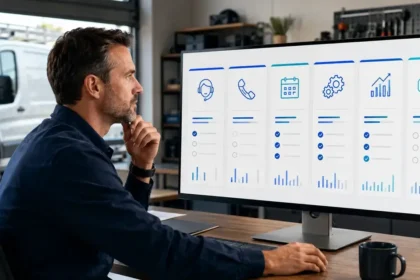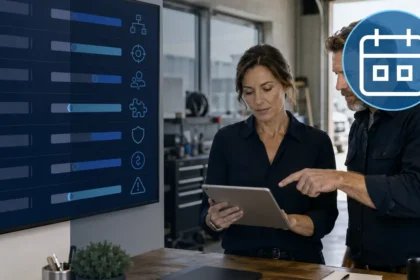

Contractors evaluating call-tracking software for home service businesses are choosing an operating method as much as a piece of software. Its value will be decided inside the cross-functional operating system, not by the number of menu items. Testing a customer record changing while an integration is delayed and an employee works offline quickly shows whether the product supports real operating pressure.
- Quick answer
- Establish the current-state baseline
- Map the work before mapping the software
- What “best” should mean in this market
- Capabilities worth proving
- Give every affected role a voice
- Replace feature claims with acceptance tests
- A field-test worksheet for call-tracking software for home service businesses
- A practical product shortlist
- Design data flows and integrations explicitly
- Apply security and privacy controls
- Calculate ownership beyond the advertised price
- Use a conservative value case
- A controlled rollout for call-tracking software for home service businesses
- Avoid predictable selection mistakes
- The first-90-days evidence board
- Frequently asked questions about call-tracking software for home service businesses
- What call-tracking software for home service businesses scenario should be tested first?
- How large should a call-tracking software for home service businesses shortlist be?
- Can the cheapest call-tracking software for home service businesses product be the right one?
- How long does a call-tracking software for home service businesses pilot need?
- Who should own call-tracking software for home service businesses after launch?
- When should a contractor replace its call-tracking software for home service businesses setup?
- Related Oivic guides
- Authoritative resources
- Make call-tracking software for home service businesses prove its place
Quick answer
Choose call-tracking software for home service businesses only after mapping the cross-functional operating system, assigning the business systems owner as a business owner, and testing normal work plus a customer record changing while an integration is delayed and an employee works offline. Compare proof—not promises—across workflow fit, mobile use, integrations, security, data export, implementation capacity and full cost. Track manual touches, correction time, cycle time and adoption after launch.
Establish the current-state baseline
Begin by recording how the cross-functional operating system works today. Capture present values for manual touches, correction time, cycle time and adoption, plus the work hidden in spreadsheets, messages and memory. New software should earn the migration, account, contract, integration and future exit that arrive with it.
Map the work before mapping the software
Draw the cross-functional operating system as a sequence of inputs, decisions, handoffs, customer messages and financial updates. Stress the map with a customer record changing while an integration is delayed and an employee works offline. Name the authoritative system at every step and specify what happens when two records disagree. Vendors can now demonstrate the company’s work instead of controlling the agenda.
What “best” should mean in this market
The best call-tracking software for home service businesses product is the one that passes mandatory scenarios at acceptable risk and ownership cost. A long feature list, a large customer count and a polished demonstration are not substitutes for proof. Score evidence for call-tracking software for home service businesses, record unresolved gaps and reject a finalist that cannot return essential records in a usable form.
Capabilities worth proving
- Workflow Fit: Measure the time and corrections required to operate workflow fit at normal volume.
- Role Usability: Run a realistic field-and-office scenario for role usability, including a manual override.
- Mobile Performance: Measure the time and corrections required to operate mobile performance at normal volume.
- Integrations: Prove integrations with the company’s own roles, permissions and exception rules.
- Security: Test security from first input through reporting instead of accepting a checkbox.
- Implementation: Test implementation from first input through reporting instead of accepting a checkbox.
- Reporting And Export: Prove reporting and export with the company’s own roles, permissions and exception rules.
Give every affected role a voice
Business ownership belongs with the business systems owner; technical administration can support that role but should not replace it. Front-office users need speed, context and a safe way to correct incomplete information. Technicians need minimal taps, readable history and a controlled offline or failure path. Finance and management need definitions they can reconcile, not decorative dashboards.
Replace feature claims with acceptance tests
An acceptance test should state the input, user, action, expected state, evidence and owner. Instead of accepting “integrates with accounting,” change an approved transaction, interrupt the connection, restore it and reconcile both systems. Score evidence consistently and flag anything demonstrated with a premium module that is absent from the quote.
A field-test worksheet for call-tracking software for home service businesses
Give each evaluator a fresh copy of the same sample record. State the role, starting condition, expected decision, permitted override and evidence to retain. Time the work, but also count questions, backtracking and corrections. The business systems owner should observe rather than coach; otherwise the trial measures product familiarity instead of usability.
After the normal case, remove one required value, change the customer’s decision, interrupt a connection and run a customer record changing while an integration is delayed and an employee works offline. Compare the final operational and financial records with the expected state. Ask field users what they would do under pressure, office users what they could safely correct, and managers how they would discover a silent error.
Close the session by exporting the affected records, attachments and audit history. Record plan edition, device, connectivity, assistance received and unresolved questions. This worksheet turns call-tracking software for home service businesses from a subjective preference into evidence another stakeholder can review.
A practical product shortlist
This is a research shortlist, not a universal ranking. Products, prices and plan limits change, and a respected platform can still be wrong for a particular trade or operating model. Ask every finalist to run the same scripted scenarios with the same sample data.
| Product | Evaluation lens |
|---|---|
| CallRail | Investigate current call-tracking software for home service businesses capabilities with emphasis on workflow depth, plan boundaries and implementation effort. Verify the quoted edition and official documentation. |
| WhatConverts | Investigate current call-tracking software for home service businesses capabilities with emphasis on workflow depth, plan boundaries and implementation effort. Verify the quoted edition and official documentation. |
| Invoca | Investigate current call-tracking software for home service businesses capabilities with emphasis on role controls, exception handling and support model. Verify the quoted edition and official documentation. |
| CallTrackingMetrics | Investigate current call-tracking software for home service businesses capabilities with emphasis on total ownership cost and proof from a scripted trial. Verify the quoted edition and official documentation. |
| Twilio | Investigate current call-tracking software for home service businesses capabilities with emphasis on workflow depth, plan boundaries and implementation effort. Verify the quoted edition and official documentation. |
Design data flows and integrations explicitly
Document the data contract around call-tracking software for home service businesses: records, fields, direction, timing, matching and ownership. Include a changed phone number, two properties, a duplicate contact and an interrupted sync. A connector is not complete until failures are visible, an owner receives them and totals can be reconciled. Test exit while the vendor still wants the business: obtain data, relationships, files and audit history.
Apply security and privacy controls
Security review for call-tracking software for home service businesses should cover multifactor authentication, role design, audit logs, encryption, backups and incident notification. Sensitive calls, payment status, employee location and property details deserve explicit retention and access decisions. A trial should not require copying a live mailbox or customer database into an unapproved environment.
Calculate ownership beyond the advertised price
| Cost layer | Include in the model |
|---|---|
| License | Users, locations, usage tiers, storage and premium call-tracking software for home service businesses modules |
| Launch | Cleanup, migration, configuration, testing and specialist help for the cross-functional operating system |
| Operation | Employee coaching, data maintenance, vendor management and reconciliation of the cross-functional operating system |
| Transition | Dual entry, cutover support, schedule disruption and extra review during stabilization |
| Exit | Usable call-tracking software for home service businesses exports, contract duties, migration assistance and verified deletion |
Use a conservative value case
A credible value case links call-tracking software for home service businesses to conservative movement in manual touches, correction time, cycle time and adoption. Include the labor required to maintain data, investigate errors, train users and manage releases. Agree on a review date and stop threshold before launch so sunk cost does not control the decision.
A controlled rollout for call-tracking software for home service businesses
- Define: publish success, risk and boundary decisions for the cross-functional operating system.
- Prepare: clean the minimum pilot records and define every call-tracking software for home service businesses field.
- Configure: build permissions, statuses, templates, alerts and recovery around the cross-functional operating system.
- Prove: run ordinary work, incomplete input, a customer record changing while an integration is delayed and an employee works offline and one deliberate failure.
- Pilot: operate at real volume without removing the documented fallback.
- Stabilize: fix data and process causes instead of normalizing repeated workarounds.
- Expand: scale the operating model after adoption, control and value are demonstrated.
Avoid predictable selection mistakes
The most common buying error is allowing a polished demonstration to replace requirements. Avoid changing process, data definitions, integrations and compensation rules on the same launch day unless the program can absorb that risk. A short decision memo for call-tracking software for home service businesses protects the team from remembering vendor promises differently after launch.
The first-90-days evidence board
- Call-tracking software for home service businesses completion and active use by office, field and management roles
- Movement in manual touches, correction time, cycle time and adoption compared with the documented baseline
- Manual touches, duplicate software records and correction minutes
- Failed call-tracking software for home service businesses connections, alert delay and reconciliation effort
- Customer questions, accessibility problems and requests for human help
- Unauthorized access, privacy concerns or security events connected with call-tracking software for home service businesses
- Actual call-tracking software for home service businesses ownership cost compared with the approved expected case
- Successful export, restore or manual-recovery exercise for the cross-functional operating system
Frequently asked questions about call-tracking software for home service businesses
What call-tracking software for home service businesses scenario should be tested first?
Use the highest-consequence path in the cross-functional operating system, then repeat it with incomplete information and a customer record changing while an integration is delayed and an employee works offline.
How large should a call-tracking software for home service businesses shortlist be?
Three to five credible products usually leave enough time for references, security review, contract comparison and hands-on testing by the business systems owner.
Can the cheapest call-tracking software for home service businesses product be the right one?
Yes, but only if it passes critical work with acceptable risk. Compare full ownership, correction effort and likely movement in manual touches, correction time, cycle time and adoption.
How long does a call-tracking software for home service businesses pilot need?
Run it until representative volume, every intended role and meaningful exceptions have occurred. The cross-functional operating system may require a longer window when work is seasonal.
Who should own call-tracking software for home service businesses after launch?
The business systems owner should answer for operating outcomes, with finance, security and technical support assigned to the controls they understand.
When should a contractor replace its call-tracking software for home service businesses setup?
Replacement is justified when verified workflow, data, support, security or scale gaps cost more than a controlled migration, and configuration or training cannot close them.
Related Oivic guides
- Contractor Accounting Software vs. General Small-Business Accounting Tools
- How to Choose Call-Tracking Software for a Contractor
- How to Audit Your Contractor Software Stack
- Contractor Technology Stack Template for Small, Growing and Multi-Location Companies
Authoritative resources
- CISA cybersecurity guidance for small businesses
- U.S. Small Business Administration cybersecurity guidance
Make call-tracking software for home service businesses prove its place
Oivic helps home service companies connect technology choices with real workflows, accountable ownership, governed data and measurable operating results.