

What Is AI Automation, Fundamentally?
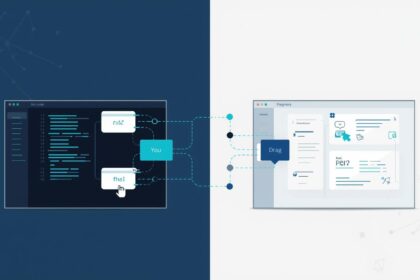
AI automation is the application of advanced artificial intelligence technologies—specifically machine learning—to automate complex business processes and tasks. It fundamentally differs from basic automation by incorporating judgment and decision-making capabilities.
- The Core Mechanics: How AI Elevates Standard Automation
- A Practical Framework for Implementing AI Automation
- Step 1: Process Identification and Audit
- Step 2: Feasibility Assessment and Goal Setting
- Step 3: Pilot, Validation, and Deployment
- Step 4: Continuous Monitoring and Refinement
- High-Impact Business Applications of AI Automation
- Case Study 1: Enhanced Customer Service Operations
- Case Study 2: Intelligent Data Processing in Finance
- Case Study 3: Optimizing Supply Chain and Logistics
- Trade-offs and Strategic Risks in Adoption
- Initial Investment and Maintenance Complexity
- Data Quality and Model Drift Challenges
- The Importance of Human-in-the-Loop Oversight
- Frequently Asked Questions (FAQ)
- How long does it take to implement AI automation?
- What size of business benefits most from AI automation?
- Is AI automation intended to replace human workers?
- What is the difference between AI and machine learning in this context?
- Which business functions are most commonly automated?
- The Strategic Takeaway: Focusing on Operational Excellence
It allows systems to handle variable inputs, learn from new data, and execute tasks that require human-like cognitive functions. The goal is not just to perform a task faster, but to perform it more intelligently and adaptively.
Why AI Automation is Not Just a Buzzword
The term moves beyond simple, pre-programmed robotic process automation (RPA). Simple automation follows rigid, explicitly defined rules.
AI automation introduces the ability to perceive, reason, and act without constant human intervention or pre-defined instructions for every scenario. This adaptive quality is what drives true operational scalability and resilience in a modern business environment.

The Core Mechanics: How AI Elevates Standard Automation
Standard automation systems are fundamentally brittle; they fail when inputs deviate slightly from the expected format. AI integration solves this by enabling the system to understand and categorize unstructured data.
This capability is the bridge between automating simple, repetitive actions and automating complex, knowledge-based workflows. It allows businesses to address the 80% of processes that were previously too complex or variable for traditional RPA.
Distinguishing AI Automation from RPA
The critical difference lies in cognitive capacity. Robotic Process Automation (RPA) executes high-volume, repetitive tasks based strictly on defined business rules.
AI automation, often called Intelligent Process Automation (IPA), leverages machine learning to handle exceptions, classify information, and make predictions. RPA is about doing the task; AI is about deciding the best way to do it.
Key Components: ML, NLP, and Computer Vision
The intelligence in AI automation relies on three primary technology stacks. Machine Learning (ML) is the engine that allows systems to learn patterns and predict outcomes from data without explicit programming.
Natural Language Processing (NLP) enables the system to read, understand, and generate human language from emails, documents, and chat transcripts. Computer Vision allows the system to interpret and act on visual data, such as images, PDFs, or video streams.
A Practical Framework for Implementing AI Automation
Implementing AI automation requires a structured, strategic approach to ensure a high return on investment and minimal disruption. It is a strategic transformation, not a simple software installation.
Step 1: Process Identification and Audit
Identify the specific processes that are high-volume, time-consuming, and require significant human cognitive effort or data classification. Prioritize areas where human error has a high cost, such as compliance and data entry.
Focus on processes with reliable, high-quality data streams, as AI models are heavily reliant on clean input for effective training and execution.
Step 2: Feasibility Assessment and Goal Setting
Determine the technical feasibility of automating the process, ensuring the necessary data infrastructure is in place. Clearly define measurable business outcomes, such as a 30% reduction in processing time or a 15% increase in data accuracy.
Resist the urge to automate poorly designed, inefficient manual processes; automation will only speed up the flawed operation.
Step 3: Pilot, Validation, and Deployment
Start with a small, controlled pilot program to train the AI model on real data and validate its accuracy against human performance. Adjust the model and process based on pilot findings.
Only after successful validation should the system be deployed more widely, often utilizing a phased rollout to manage risk.
Step 4: Continuous Monitoring and Refinement
AI models are not static; they degrade over time due to changes in data patterns, a phenomenon known as model drift. Establish systems for continuous monitoring of performance and accuracy.
Regularly retraining the model with new, relevant data is essential to maintain optimal operational efficiency and adaptability.

High-Impact Business Applications of AI Automation
AI automation is not limited to back-office tasks; it drives significant efficiency and accuracy across multiple business functions.
Case Study 1: Enhanced Customer Service Operations
Intelligent Virtual Agents use NLP and ML to handle a majority of customer inquiries, from initial categorization to complex resolution. The AI understands the intent of the query and provides relevant resources or routes the request to the specific, best-suited human agent.
This reduces the workload on support staff and cuts average handling time while improving customer satisfaction.
Case Study 2: Intelligent Data Processing in Finance
In financial operations, AI automatically extracts and validates critical data from invoices, contracts, and compliance documents. It uses computer vision and ML to classify documents and flag anomalies that might indicate fraud or non-compliance.
This vastly accelerates the closing process and reduces regulatory risk associated with manual data entry.
Case Study 3: Optimizing Supply Chain and Logistics
AI models analyze real-time inventory levels, historical demand patterns, and external variables like weather to predict optimal stock levels and delivery routes. This is known as Predictive Logistics.
Automation handles the dynamic re-routing of shipments and the automated ordering of supplies, leading to lower operating costs and faster fulfillment.
Trade-offs and Strategic Risks in Adoption
While the benefits are clear, strategic implementation requires an honest assessment of the associated challenges and costs. Automation is not a panacea.
Initial Investment and Maintenance Complexity
AI automation systems require significant upfront investment in specialized software, data infrastructure, and training data. Furthermore, maintaining the system is more complex than simple software, necessitating skilled data scientists and engineers to manage model performance.
The Total Cost of Ownership (TCO) is higher and less predictable than traditional IT systems.
Data Quality and Model Drift Challenges
The performance of any AI automation system is directly proportional to the quality and volume of its training data. Poor data leads to poor decisions (Garbage In, Garbage Out).
Moreover, if the underlying business reality changes, the deployed model’s accuracy will degrade (model drift), requiring costly retraining and recalibration.
The Importance of Human-in-the-Loop Oversight
AI systems should not be deployed as black boxes. Human oversight, or Human-in-the-Loop (HITL) processes, is necessary to review system decisions, handle exceptions, and provide corrective feedback.
Removing humans entirely risks institutionalizing errors or making high-stakes decisions without ethical or contextual review.
Frequently Asked Questions (FAQ)
How long does it take to implement AI automation?
Implementation time varies significantly based on the complexity of the process and the readiness of the data infrastructure. A focused project can take between 3 and 9 months, including pilot and deployment.
What size of business benefits most from AI automation?
Businesses of all sizes benefit, but those with high-volume, standardized, and data-rich processes often see the fastest return on investment. Mid-to-large enterprises with complex legacy systems see the most significant gains in operational efficiency.
Is AI automation intended to replace human workers?
The strategic goal is generally not replacement but augmentation. Automation handles the tedious, repetitive tasks, freeing human staff to focus on critical thinking, creative problem-solving, and complex customer interactions.
What is the difference between AI and machine learning in this context?
AI is the broad field of creating systems that mimic human intelligence. Machine Learning (ML) is a specific method within AI that enables systems to learn from data without explicit programming, making it the core technology of modern AI automation.
Which business functions are most commonly automated?
Functions rich in repeatable data processes are common targets, including finance (invoicing, accounts payable), customer service (ticketing, routing), and Human Resources (onboarding, payroll processing).
The Strategic Takeaway: Focusing on Operational Excellence
AI automation is a strategic lever for operational excellence, not merely a cost-cutting measure. It enables businesses to operate at a scale and speed unattainable by manual processes alone.
The successful path forward involves a targeted, data-centric approach, focusing on enhancing the quality and intelligence of critical workflows. This is the foundation of future-proof digital transformation.