

E-commerce businesses risk losing valuable customers at every stage of the buying journey—product discovery, evaluation, checkout, and post-purchase. Harnessing AI automation transforms conversion rates by actively eliminating costly friction points and delivering personalized experiences proven to motivate purchase decisions.
- Understanding Conversion Rate Improvement Through Automation
- Primary Ways AI Automation Increases E-Commerce Conversions
- Personalized Product Recommendations
- Dynamic Pricing and Promotion Optimization
- Abandoned Cart Recovery Automation
- Intelligent Search and Navigation
- Chatbots and Conversational Commerce
- Behavioral Trigger Campaigns
- Conversion Impact Across Different E-Commerce Models
- High-Volume, Low-Consideration Purchases
- High-Consideration, Complex Products
- B2B and Wholesale E-Commerce
- Implementation Framework for E-Commerce Conversion Automation
- Step 1: Identify Highest-Impact Opportunities
- Step 2: Select Appropriate Automation Capabilities
- Step 3: Ensure Technical Prerequisites
- Step 4: Implement with Controlled Testing
- Step 5: Optimize and Expand
- Limitations and Risks of Conversion Automation
- Over-Personalization and Privacy Concerns
- Algorithm Bias and Narrow Recommendations
- Technical Failures and Customer Experience Impact
- Implementation Costs Versus Benefits
- Common Mistakes That Limit Conversion Improvement
- Measuring True Impact of Conversion Automation
- Frequently Asked Questions
- Strategic Approach to Conversion Automation
This article examines the specific conversion improvements that AI automation delivers and highlights where it has the greatest impact. Next, it explores how to implement these capabilities without disrupting existing operations. As a result, you’ll understand which automation approaches work for different business models and what results to expect.
Understanding Conversion Rate Improvement Through Automation
Conversion rate refers to the percentage of website visitors who take a desired action, such as making a purchase. Improving this rate means generating more sales from the same number of visitors, increasing revenue without additional advertising spend.
AI automation improves conversions by collecting and studying actions customers take on a website, anticipating when someone might make a purchase, and adjusting what individual users see in real time based on each person’s unique characteristics. These systems determine which strategies are most effective for different customer groups and automatically apply that knowledge to improve results.
Automation is crucial because manual optimization can never match the unprecedented speed and scale of AI-powered systems. When thousands of products and segments are involved, only automated analysis and execution deliver competitive results quickly and reliably.
Traditional conversion optimization relies on periodic analysis and manual implementation. AI automation continuously optimizes experiences as new data becomes available, maintaining the momentum for improvement that human teams cannot sustain.
Primary Ways AI Automation Increases E-Commerce Conversions
Personalized Product Recommendations
Product recommendation systems use data about a customer’s past purchases, browsing activity, and the behavior of customers with similar interests to suggest products most likely to appeal to each individual shopper.
Generic recommendations, such as “best sellers” or “recently viewed,” consistently convert at significantly lower rates than personalized suggestions tailored to individual behavior and preferences. Customers are far more likely to purchase products they discover through relevant, targeted recommendations.
Cross-sell and upsell recommendations appear at optimal moments in the shopping journey. Systems determine when customers are receptive to additional products based on behavioral signals rather than arbitrary page placements.
Recommendation accuracy improves continuously as systems learn from more customer interactions. Each purchase, product view, and search query refines the model’s understanding of what drives individual buying decisions.
Businesses can unlock 10-30% revenue growth by leveraging recommendation engines once properly implemented. This powerful impact is further influenced by your catalog size, customer base diversity, and the strength of the recommendation algorithm.
Dynamic Pricing and Promotion Optimization
Automated pricing systems use software to adjust product prices and create promotional offers based on consumer demand, competitors’ prices, available stock, and each customer’s price sensitivity.
Price optimization powerfully increases conversion by strategically balancing margin and volume for every product and customer segment. While some customers eagerly convert at full price, others need targeted discounts, and advanced automation ensures the right approach maximizes results for each group.
Personalized promotion timing delivers offers when individual customers are most likely to purchase. Systems analyze purchase cycles and engagement patterns to determine optimal moments for promotional messages.
Inventory-based pricing prevents stockouts of high-demand items while clearing slow-moving products through targeted price reductions. Automation balances conversion rate with inventory efficiency across the entire catalog.
Dynamic pricing requires careful implementation to avoid customer frustration from perceived unfairness. Transparent pricing strategies with clear logic behind the variations maintain trust while optimizing conversion rates.
Abandoned Cart Recovery Automation
Cart abandonment costs e-commerce businesses 60-80% of shopping sessions. Automated recovery systems relentlessly pursue abandoned carts and deploy highly personalized outreach that has been proven to secure lost sales.
Recovery timing matters significantly for effectiveness. Systems determine optimal wait periods before sending recovery messages based on product category, cart value, and individual customer responsiveness patterns.
Message personalization beyond basic cart content improves recovery rates. Automation includes relevant product details, addresses common objections, and adjusts incentive offers based on abandonment reasons and customer value.
Multi-channel recovery means reaching out to customers through several communication methods, including email, text messages (SMS), push notifications on their devices, and online advertisements, depending on which channel a customer prefers and responds to best.
High-performing cart recovery strategies routinely convert 10-15% of abandoned sessions into successful purchases. This unlocks substantial revenue from existing traffic, amplifying overall conversion without spending more on acquisition.
Intelligent Search and Navigation
Search functionality is a powerful driver of conversion rates—customers who use site search are 2-3 times more likely to convert than those who don’t. Ensuring that search returns relevant results is essential to unlocking this potential.
Natural language processing enables search systems to understand the user intent behind queries rather than matching keywords literally. Searches for “blue shirt men” and “men’s azure button-down” return results that are appropriately similar.
Autocomplete and query suggestions help customers complete their searches faster and more accurately. As users type, the system predicts possible search terms based on previous queries and favors suggestions that have led to more purchases.
Search result personalization means the site orders and displays products so that those most relevant to an individual customer’s preferences and buying habits appear first, rather than using the same order for all shoppers.
Visual search lets customers find products by uploading or taking photos, rather than typing a description. This is especially useful in categories where it is difficult for people to describe what they are looking for in words.
Chatbots and Conversational Commerce
Automated chat systems answer customer questions, provide product recommendations, and guide purchase decisions without human agent involvement.
Question resolution reduces conversion friction by addressing concerns before they cause abandonment. Customers receive immediate answers rather than leaving to research elsewhere or contacting support channels with delayed responses.
Conversational product discovery helps customers find appropriate products through dialogue rather than navigation and search. This works particularly well for complex products requiring clarification of needs and preferences.
Purchase assistance through checkout reduces form abandonment by helping customers complete transactions smoothly. Automated systems identify checkout friction points and intervene to assist customers before they abandon.
Post-purchase support is crucial for building confidence and directly drives initial purchases. Customers are far more likely to buy from stores that offer reliable support when needed.
Behavioral Trigger Campaigns
Automated campaigns respond to specific customer actions or inactions with targeted messages designed to drive conversion at optimal moments.
Browse abandonment campaigns reach customers who viewed products but didn’t add them to the cart. These campaigns convert interest into initial cart creation, advancing customers along the purchase journey.
Price drop notifications automatically inform customers when products they viewed decrease in price. This capitalizes on demonstrated interest while providing compelling reasons to complete purchases.
Back-in-stock alerts reach customers who showed interest in out-of-stock items. These campaigns capture demand that would otherwise be lost to competitors.
Post-purchase cross-sell campaigns identify complementary products customers are likely to need based on their recent purchases. Timing these campaigns appropriately yields high conversion from customers already in buying mode.
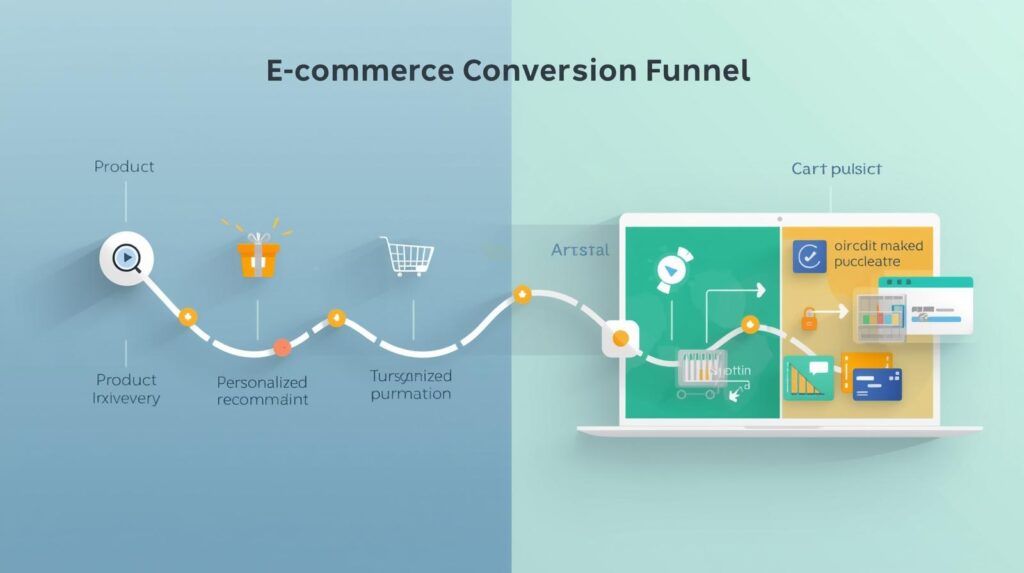
Conversion Impact Across Different E-Commerce Models
High-Volume, Low-Consideration Purchases
Businesses selling consumables, basic apparel, and frequently purchased items see strong conversion improvements from recommendation engines and simplified checkout processes.
Purchase decisions happen quickly with minimal research. Automation that reduces friction and surfaces relevant products at the right moment drives significant increases in conversion.
Subscription conversion particularly benefits from automated optimization. Systems test pricing models, trial periods, and offer structures to maximize subscription adoption rates.
High-Consideration, Complex Products
Electronics, furniture, and other complex purchases require more customer education and confidence-building. Conversational systems and educational content automation prove most valuable.
Comparison tools that automatically generate side-by-side product evaluations help customers make informed decisions without leaving the site. This reduces research-related abandonment.
A financing option presentation significantly affects conversion for high-value items. Automated systems determine when and how to present payment plans based on cart value and customer characteristics.
B2B and Wholesale E-Commerce
Business buyers follow different decision processes requiring quote generation, approval workflows, and volume pricing. Automation must address these specific needs to improve conversion.
Automated quote systems generate accurate pricing for complex orders immediately, rather than requiring sales team involvement. This speeds buying cycles and improves conversion of quote requests into orders.
Approval workflow automation routes orders through proper channels without manual intervention. Reducing friction in organizational buying processes increases completion rates.
Account-specific pricing and catalog customization show business customers only relevant products and appropriate pricing. This streamlines the buying experience and improves conversion efficiency.
Implementation Framework for E-Commerce Conversion Automation
Step 1: Identify Highest-Impact Opportunities
Analyze your current conversion funnel to identify where customers most frequently abandon and which improvements would deliver the greatest revenue impact.
Calculate drop-off rates at each funnel stage: from the homepage to product pages, from product pages to the cart, from the cart to checkout initiation, and from checkout to a completed purchase. Focus automation on the largest drop-off points.
Segment analysis reveals whether conversion issues affect all customers or specific segments. Problems concentrated in particular segments may require targeted automation approaches rather than site-wide changes.
Revenue impact assessment prioritizes opportunities by potential return. A 5% improvement in converting high-value customers matters more than a 10% improvement in converting low-value customers.
Step 2: Select Appropriate Automation Capabilities
Match automation capabilities to identified opportunities based on your specific business model, technical infrastructure, and customer needs.
Product recommendation engines deliver the strongest impact for catalogs with 50+ products, where customers benefit from guided discovery. Smaller catalogs may not justify the complexity of a recommendation system.
Chat automation works best when you receive consistent volumes of similar customer questions. Unique, complex inquiries still require human handling, limiting the value of automation for highly specialized products.
Dynamic pricing suits businesses with flexible pricing strategies and competitive markets. Fixed-price retailers or brands with strict pricing policies cannot leverage these capabilities.
Step 3: Ensure Technical Prerequisites
Verify that your platform supports the desired automation capabilities before implementation. Missing infrastructure requirements cause project delays and suboptimal results.
Data collection must capture customer behavior, product interactions, and transaction details. Automation systems require historical data to identify patterns and make accurate predictions.
Integration capabilities enable automation systems to connect with your e-commerce platform, inventory management system, CRM, and marketing tools. Poor integration limits effectiveness and creates manual work.
Platform performance must support automation without degrading customer experience. Slow-loading personalized content converts worse than fast-loading generic content.
Step 4: Implement with Controlled Testing
Deploy automation capabilities incrementally with proper testing rather than replacing all existing approaches simultaneously.
A/B testing compares automated approaches with current methods to validate improvements before a full rollout. Continue manual processes in parallel until automation proves superior.
Segment testing first applies automation to specific customer groups. This limits the potential negative impact while gathering performance data before broader implementation.
Monitoring conversion metrics, customer satisfaction, and revenue impact identifies whether automation delivers expected benefits or requires adjustment.
Step 5: Optimize and Expand
Continuously refine automation based on performance data and evolving customer behavior rather than treating implementation as a one-time project.
Regular analysis identifies automation elements performing below expectations. Systems require ongoing adjustment as customer preferences and competitive dynamics change.
Gradual expansion applies successful automation approaches to additional areas. Prove effectiveness in one area before investing in automation across all conversion points.
Limitations and Risks of Conversion Automation
Over-Personalization and Privacy Concerns
Excessive personalization can feel intrusive to customers, particularly when recommendations reveal too much about tracked behavior. This discomfort undermines trust and hinders conversion rather than fostering it.
Privacy regulations, including GDPR and CCPA, restrict what customer data businesses can collect and how they can use it for personalization. Non-compliance creates legal liability and customer backlash.
Transparent data practices build trust that supports conversion. Clear communication about what data you collect and how it improves customer experience makes personalization acceptable rather than creepy.
Algorithm Bias and Narrow Recommendations
Recommendation algorithms can create filter bubbles, where customers see only products similar to their past purchases. This limits discovery and reduces conversion opportunities for new product categories.
Popularity bias causes systems to over-recommend best-selling products while neglecting long-tail inventory. Conversion increases for popular items, but overall catalog performance suffers.
Balancing exploitation of known preferences with exploration of new possibilities requires intentional algorithm design. Purely optimizing for immediate conversion can reduce long-term customer value.
Technical Failures and Customer Experience Impact
Automation failures create poor customer experiences that harm conversion more than a lack of automation. A broken recommendation engine that shows irrelevant products converts worse than no recommendations at all.
System dependence creates vulnerability to technical issues. When automation handles critical conversion functions, outages directly impact revenue until they are resolved.
Fallback mechanisms maintain basic functionality when automation fails. Sites should degrade gracefully rather than breaking completely when AI systems experience problems.
Implementation Costs Versus Benefits
Sophisticated automation requires significant investment in technology, integration, and ongoing optimization. Small businesses may find that costs exceed the value of the conversion improvement.
Maintenance requirements continue after initial implementation. Automation systems need monitoring, updating, and adjustment to maintain effectiveness as business conditions change.
ROI calculations must include total ownership costs beyond initial software expenses. Factor in integration work, staff training, ongoing management, and periodic retraining of models.
Common Mistakes That Limit Conversion Improvement
Organizations often implement automation without properly understanding customer friction points. They automate the wrong areas while actual conversion barriers remain unaddressed.
Many businesses fail to collect sufficient quality data before implementing automation. Systems trained on incomplete or inaccurate data produce poor recommendations that reduce conversion rates rather than improve them.
Some companies automate too much, too quickly, without validating effectiveness. They replace working processes with untested automation that performs worse than previous approaches.
Others neglect mobile experience when implementing conversion automation. Mobile accounts for 50-70% of e-commerce traffic, yet automation is often designed primarily for desktop experiences.
Businesses frequently set unrealistic expectations for immediate improvement. Conversion optimization through automation requires time for systems to learn patterns and for optimization to compound.
Many organizations implement automation but fail to maintain it properly. Conversion improvement degrades as customer preferences shift and automation systems become outdated.
Measuring True Impact of Conversion Automation
Revenue attribution determines what portion of sales results from automation versus organic conversion. Implement tracking that isolates automation impact from other factors affecting conversion rates.
Incrementality testing measures additional conversions automation generates beyond baseline performance. Compare conversion rates for customers exposed to automation with those in control groups experiencing standard experiences.
Customer lifetime value assessment determines whether automation increases immediate conversion at the expense of long-term value. Some aggressive automation tactics improve short-term conversion while harming retention.
Return on investment calculations account for all costs, including technology, implementation, maintenance, and opportunity costs of staff time. True ROI provides accurate decision-making information.
Cohort analysis tracks how conversion rates change over time for customers exposed to automation. This reveals whether benefits persist or diminish as novelty wears off.
Frequently Asked Questions
How long does it take to see conversion improvements from AI automation?
Simple automation, such as cart recovery emails, shows impact within weeks of implementation. Sophisticated personalization and recommendation engines typically require 2-3 months to gather sufficient data and demonstrate measurable improvement. Systems need time to learn customer behavior before they can optimize effectively. Expect gradual improvement rather than immediate dramatic changes.
What conversion rate improvement should we expect from AI automation?
Typical improvements range from 10% to 30% in conversion rate, depending on starting performance, automation sophistication, and implementation quality. A site converting at 2% might reach 2.2-2.6% with effective automation. Businesses with minimal existing optimization see larger gains than those already running optimized operations. Specific results depend on your product category, customer base, and which automation capabilities you implement.
Do we need a large product catalog for recommendation engines to work?
Recommendation engines work best with catalogs of 50+ products where customers benefit from discovery assistance. Smaller catalogs offer limited value, as customers can easily browse all options manually. However, businesses with small catalogs and high repeat-purchase frequency can still benefit from personalized reorder suggestions based on purchase history.
Can small e-commerce businesses afford conversion automation?
Entry-level automation, including basic cart recovery, simple chatbots, and template-based personalization, costs $100-$500 per month and suits small businesses. Sophisticated recommendation engines and dynamic pricing typically require $1,000+ in monthly fees, plus implementation costs, making them more appropriate for businesses generating $50,000+ in monthly revenue. Calculate the potential revenue increase relative to total costs to determine affordability for your specific situation.
How do we prevent automation from making our site feel impersonal?
Maintain human touchpoints alongside automation by combining automated efficiency with authentic brand voice in messaging, providing easy access to human support when customers need it, and ensuring personalization enhances rather than replaces genuine customer service. Transparency about using automation to improve experience rather than manipulate purchases builds trust that supports conversion.
Strategic Approach to Conversion Automation
AI automation improves e-commerce conversions most effectively when implemented strategically, based on actual customer friction points, rather than deployed for its own sake.
Start with a thorough analysis of your current conversion funnel to identify where customers abandon and why. Match automation capabilities to specific problems rather than implementing everything available.
Focus on improving the customer experience as the goal, with increased conversion as the outcome. Automation that genuinely helps customers make better decisions drives sustainable improvements in conversion. Manipulation tactics may boost short-term metrics while harming long-term business health.
Implement incrementally with proper testing and measurement at each stage. Validate effectiveness before expanding to additional areas. This approach reduces risk while building organizational confidence in the value of automation.
Remember that conversion automation requires ongoing attention rather than set-and-forget implementation. Customer behavior evolves, competitive dynamics shift, and automation systems need continuous refinement to maintain effectiveness. Treat conversion optimization as an ongoing program rather than a one-time project.