

Forms are critical conversion points. Prospects become leads and browsers become customers here. Yet, many businesses only realize months later that submissions went untracked, attribution stayed unclear, or double-counting inflated conversion metrics. A recent study found that mis-tracked forms cost firms an average of $5,000 per month, highlighting the tangible financial impact of poor form tracking.
- Why Accurate Form Tracking Matters
- Understanding Form Tracking Mechanisms
- The Fundamental Challenge of Form Tracking
- Step-by-Step Implementation Framework
- Thank-You Page Tracking Method
- Event-Based Form Tracking Implementation
- Tag Manager Implementation Strategy
- Tracking Multiple Forms on Single Pages
- Validation and Accuracy Verification
- Common Tracking Errors and Solutions
- Privacy and Compliance in Form Tracking
- Attribution and Source Tracking
- Advanced Tracking for Multi-Step Forms
- Form Analytics Beyond Basic Tracking
- Integration With CRM and Marketing Systems
- Server-Side Tracking Advantages
- Mobile Form Tracking Considerations
- Testing and Quality Assurance Protocol
- Troubleshooting Common Issues
- Long-Term Maintenance Requirements
- When to Seek Technical Assistance
- Frequently Asked Questions
- Key Takeaways
Learning to track form submissions accurately ensures every lead is captured, marketing attribution stays reliable, and optimization efforts target real issues. With airtight tracking, every campaign dollar becomes traceable and optimizable, transforming your strategy’s effectiveness. Effective implementation requires understanding tracking mechanisms, avoiding common pitfalls, and validating data. This guide gives a systematic approach to form tracking that works across platforms and scales with growth.
Why Accurate Form Tracking Matters
Form submissions often represent the highest-value conversions on websites. Contact forms, quote requests, consultation bookings, and lead captures directly generate sales opportunities, unlike passive metrics such as page views.
Inaccurate tracking creates multiple business problems. Lost submissions mean missed sales opportunities and wasted marketing spend, leading to unrecorded conversions. Double-counting inflates success metrics, leading to poor budget allocation decisions. For instance, mis-attribution might cause a marketing team to believe a particular campaign is performing better than it actually is. This inflated metric could lead them to invest an additional $10,000 into an underperforming channel, ultimately wasting resources and missing opportunities to optimize spending elsewhere.
Attribution relies on precise form tracking. Knowing which channels, campaigns, or content drive submissions lets you allocate budget wisely and refine strategies.
Conversion rate optimization needs reliable baseline data. Testing form variations or page improvements means accurately measuring submission rates to see whether changes work.
Understanding Form Tracking Mechanisms
Form tracking monitors when visitors complete and submit forms. Implementation methods range from simple page-based tracking to sophisticated event monitoring, capturing granular interaction data.
Thank-you page tracking is simple. Users submit forms and land on confirmation pages. Tracking these page views shows successful submissions.
Event-based tracking monitors submit button clicks or form submission events directly. This method records submissions even if thank-you pages fail to load or users leave quickly.
JavaScript listeners watch for form submissions. Code detects submit button clicks and triggers tracking before page navigation.
Server-side tracking logs submissions at the application level. Backend systems record form data and trigger tracking. This works independently of browser-based JavaScript.
The Fundamental Challenge of Form Tracking
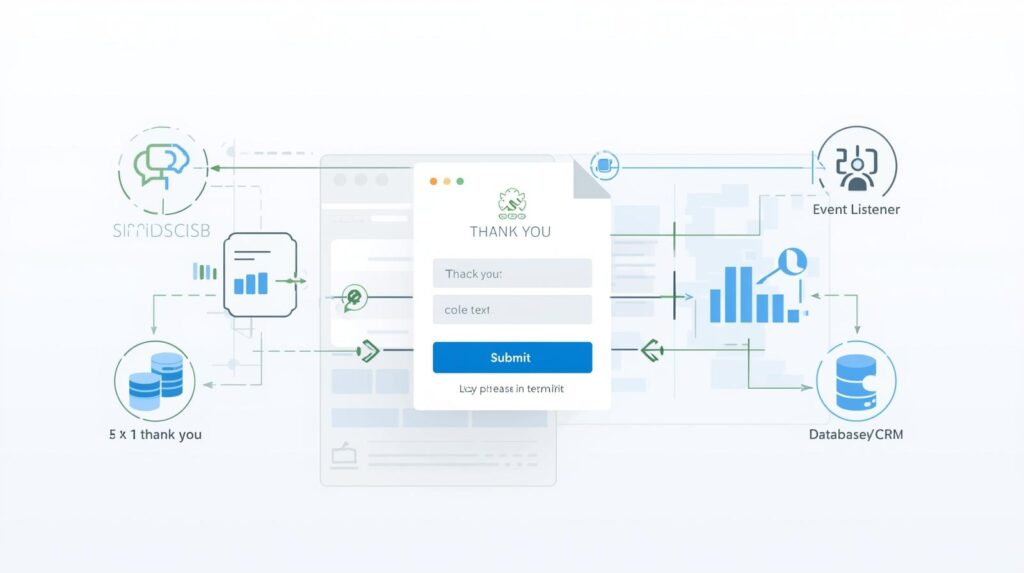
Forms create unique tracking complexity because submission actions trigger page navigation Tracking often dies in the split-second between ‘Submit’ and the next page.. When users click submit, browsers begin loading new pages, potentially interrupting the execution of tracking code.
Timing issues cause data loss. If tracking fires after navigation begins, the code may never complete execution, resulting in the loss of all submission data.
Page redirects complicate matters further. Forms that redirect to external domains or trigger downloads may leave insufficient time for the tracking code to transmit data.
Multiple tracking setups risk double-counting. Organizations using multiple analytics platforms or conversion pixels may record a single submission multiple times if their configurations overlap.
Spam and bot submissions can inflate counts. Automated form fills from bots or scrapers trigger tracking without real leads. This distorts conversion metrics.
Step-by-Step Implementation Framework
- Define what counts as a trackable submission. Identify which forms on your site are worth tracking for conversions. These could include contact forms, quote requests, newsletter signups, or demo requests.
- Choose your primary tracking method based on site structure. Thank-you page tracking works well for simple implementations, while event tracking is better suited to complex sites with dynamic forms.
- Place tracking code as your platform instructs. Each analytics or conversion system offers documentation for form submission monitoring.
- Set up submission confirmation mechanisms. Ensure users receive clear feedback after submitting forms. This improves the user experience and enables thank-you page tracking.
- Test thoroughly across devices and browsers. Submit test forms from different environments, verifying that tracking fires correctly in all scenarios.
- Establish validation processes checking tracking accuracy against actual submissions. Compare tracked conversions to form entries in your database or CRM system regularly.
- Document your implementation for future reference. Record which tracking methods you use, where codes are placed, and how to troubleshoot common issues.

Thank-You Page Tracking Method
- Thank-you page tracking treats confirmation page views as submission proxies. When users land on pages accessible only after form submission, those page views count as conversions.
- Create dedicated thank-you pages for each important form. Unique URLs for different form types enable tracking submission sources separately rather than aggregating all forms together.
- Ensure thank-you pages load only after successful submissions. Pages accessible via direct URLs or via navigation are counted as conversions when tracked.
- Configure analytics to track thank-you page views as conversion events. Set up goals or events specifically monitoring these confirmation page loads.
- Implement clear user communication on confirmation pages. Thank users for their submissions, set expectations about response timing, and provide next steps.
- The method’s simplicity makes it accessible to non-technical teams. No JavaScript coding or complex event tracking required—just page view monitoring.
One of the limitations of thank-you page tracking is that it may fail if users close their browsers too quickly after submission. If a visitor navigates away from the thank-you page almost immediately, it might not have enough time to notify your analytics, which could result in missed tracking data.
Event-Based Form Tracking Implementation
Event tracking monitors form submission actions directly rather than relying on subsequent page loads. This approach captures submissions even when confirmation pages fail to load or when users navigate away.
JavaScript event listeners attach to form submit buttons or form elements themselves. When submission occurs, the listener detects the action and fires tracking code.
Tracking fires before page navigation completes. Event-based implementations execute immediately upon submission action, preceding the redirect to thank-you pages.
Platform-specific implementation varies by analytics system. Google Analytics uses gtag or dataLayer.push commands, while advertising pixels use platform-specific event methods.
Example implementation attaches listeners to forms by ID or class. Code identifies specific forms, listens for submit events, and triggers tracking when they are detected.
Beacon API ensures tracking completes despite navigation. Modern tracking methods use a navigator.sendBeacon allows data transmission even as pages unload.
Testing requires developer tools to confirm that events fire correctly. Browser consoles show whether tracking code executes when forms submit, revealing implementation problems before they lose data.
Tag Manager Implementation Strategy
- Tag management systems centralize the deployment of tracking codes. Rather than editing website code directly, marketers configure tracking through management interfaces.
- Google Tag Manager provides free tag deployment capabilities. The platform supports form submission tracking through built-in triggers and variables without custom coding.
- Form submission triggers detect when users submit forms. Configure triggers to fire on all forms or specific forms based on IDs, classes, or other attributes.
- Built-in variables capture form data, including form ID, submission URL, and field values. This information enriches conversion data, enabling more detailed analysis.
- Tags fire when triggers activate. Configure analytics events, advertising conversion pixels, or other tracking when form submission triggers activate.
- Preview mode tests implementations before publishing. Submit forms while previewing to verify tags fire correctly and capture intended data.
- Version control enables reverting problematic changes. If new configurations break tracking, restore previous working versions immediately.
Tracking Multiple Forms on Single Pages
Pages containing multiple forms require differentiation between submissions. Contact forms, newsletter signups, and comment forms on the same page need separate tracking. To make this process actionable, consider using unique form IDs. For example, implement a code snippet like “<form id=’contact-form’>” to assign distinct identifiers to each form. This approach not only clarifies the tracking configuration but also speeds up the implementation process for your team.
Form identification uses IDs, classes, or names to distinguish forms. Ensure each form has unique identifiers that enable specific tracking configurations.
Separate conversion events for each form type provide granular data. Track contact form submissions differently from newsletter signups, enabling independent performance analysis.
Event labels or parameters categorize submissions. Include form type information in tracking calls to enable segmentation in analytics reports.
Testing must verify correct form identification. Submit each form independently, confirming the right tracking fires for each form type.
Validation and Accuracy Verification
Comparing tracked submissions to actual database entries reveals accuracy. Export form submissions from your CRM or database, then compare counts to analytics conversion data.
Discrepancies indicate tracking problems requiring investigation. Consistently higher tracked conversions suggest double-counting, while lower numbers indicate lost submissions.
Time-based analysis helps identify intermittent issues. Daily or weekly validation catches problems quickly, preventing substantial data loss from accumulating.
Always ensure your tracking implementation not only matches form entries but also reliably captures all meaningful submissions. By systematically validating and reviewing your tracking setup, you can confidently assess your actual conversion performance and make informed optimization decisions.
Bot filtering reduces false positives. Implement CAPTCHA, honeypot fields, or reCAPTCHA to prevent automated submissions from inflating conversion counts.
Common Tracking Errors and Solutions
Double-counting occurs when multiple tracking implementations fire for single submissions. Audit all tracking codes to ensure only one instance captures each conversion.
Lost submissions occur when the tracking code executes too slowly. Implement a beacon API or callback functions to ensure data is transmitted before page navigation.
Missing conversions from some traffic sources suggest cross-domain issues. Configure cross-domain tracking properly when forms submit to different domains.
Inconsistent tracking across devices indicates browser-specific problems. Test extensively on mobile devices, different browsers, and various operating systems.
Spam submissions inflating counts require filtering mechanisms. Implement validation to prevent obvious bot traffic from triggering conversion tracking.
Privacy and Compliance in Form Tracking
Personal data captured through forms requires careful handling, as many form fields contain personally identifiable information. This data is subject to privacy regulations like GDPR and CCPA.
One way to ensure compliance is to avoid tracking unnecessary form field contents. Ask yourself: What personal data is truly needed for your purposes? This question can prompt leaner tracking setups and honor data-minimization principles. Record that submissions occurred without capturing sensitive information like names, emails, or phone numbers in analytics unless absolutely necessary.
Encourage your team to create a list identifying fields that can be safely omitted, focusing on only essential data for conversion and marketing analysis. By doing so, you support compliance efforts and minimize potential privacy risks.
Consent management systems should control form tracking. Ensure that only submissions from users who have consented to analytics cookies and data collection are tracked. Following data minimization principles means capturing only essential information, as submission counts and source attribution usually matter more than field-level data for most optimization purposes.
Geographic considerations affect tracking requirements, as regulations such as GDPR, CCPA, and others impose different obligations based on user locations.

Attribution and Source Tracking
UTM parameters preserve campaign attribution through form submissions. Capture source information when users arrive and maintain it throughout the form submission process.
Hidden form fields store attribution data. Include fields capturing referral source, campaign parameters, or landing page information submitted with form data.
First-party cookies maintain attribution across sessions. Set cookies to store source information when users first arrive, and retrieve those values during form submission tracking.
Multi-touch attribution requires comprehensive journey tracking. Record all touchpoints leading to submission rather than just the immediate source.
CRM integration connects tracked submissions to complete customer records. Push attribution data into customer relationship management systems for full visibility.
Advanced Tracking for Multi-Step Forms
Multi-step forms present unique tracking challenges. Users may complete initial steps without completing the entire form, requiring step-level tracking beyond final submission. By focusing on a ‘golden metric’, such as the step-to-step drop-off rate, businesses can effectively optimize these forms. Identifying the exact steps where users abandon the form helps prevent analysis paralysis and directs attention to critical areas for improvement.
Abandonment tracking identifies friction points. Fire events when users exit multi-step forms without completing them, showing which steps cause problems.
Conditional logic in forms requires sophisticated tracking. Forms that show or hide fields based on previous answers need tracking to account for different possible paths.
Save-and-resume functionality complicates attribution. Users who start forms in one session and complete them later may have different source attribution at completion.
Form Analytics Beyond Basic Tracking
Field-level interaction data reveals optimization opportunities. Track time spent on each field, correction frequency, and abandonment points within forms.
Validation error tracking shows which fields confuse users. Monitor which input fields trigger the most validation errors, indicating unclear instructions.
Completion time analysis identifies issues with form length. Measure how long successful submissions take compared to abandoned attempts, revealing length-related friction.
Device-specific performance differences inform optimization. Compare form submission rates and completion times across mobile, tablet, and desktop devices.
A/B testing form variations requires a proper tracking infrastructure. Ensure tracking differentiates between form versions, enabling statistical comparison.
Integration With CRM and Marketing Systems
Webhook integration sends submission data to external systems immediately. Configure forms to notify CRM platforms, email services, or marketing automation systems when submissions occur. Imagine a sales representative calling a lead within five minutes, thanks to a webhook-triggered alert. This rapid response can significantly enhance lead conversion rates, demonstrating the real-time payoff that quick integrations offer. API connections enable bidirectional data flow. Push form submissions to CRM systems while pulling back enrichment data for analytics.
Zapier-style automation connects forms to hundreds of applications. Trigger workflows in various business systems automatically when forms are submitted.
Data consistency across systems requires unique identifiers. Generate submission IDs or use email addresses as keys linking records across platforms.
Real-time synchronization enables immediate follow-up. Sales teams can contact leads within minutes when form submissions trigger instant CRM notifications.
Server-Side Tracking Advantages
Server-side form tracking processes submissions at the application level. Backend systems log submissions independent of browser-based JavaScript, improving reliability.
Ad blocker immunity keeps tracking accurately. Browser extensions blocking JavaScript tracking cannot prevent server-side logging of form submissions.
Complete control over data transmission eliminates browser-dependent failures. Server code reliably sends tracking data regardless of client-side issues.
Enhanced security protects against client-side manipulation. Users cannot disable or modify server-side tracking through browser developer tools.
Implementation requires development resources. Server-side tracking requires programming skills and backend access, which are unavailable to many marketing teams.
Mobile Form Tracking Considerations
Mobile devices pose unique form-tracking challenges. Smaller screens, touch interfaces, and variable connectivity affect both form usability and tracking reliability.
Touch-friendly form design improves submission rates. Adequate button sizes, clear labels, and appropriate input types for mobile devices reduce friction.
Network interruptions during submission may result in the loss of tracking data. Mobile users on cellular networks experience dropouts, which can prevent the execution of tracking code.
App-based forms require different tracking approaches. Native mobile applications need SDK implementation rather than web-based JavaScript tracking.
Responsive design testing ensures forms work across device sizes. Test submission processes and tracking accuracy on actual mobile devices, not just desktop browsers.
Testing and Quality Assurance Protocol
Pre-launch testing prevents production tracking failures. Submit test forms across multiple browsers and devices before implementing them live.
Automated testing scripts can verify form functionality. Selenium or similar frameworks programmatically test form submissions to confirm that tracking fires correctly.
Staging environment testing isolates problems from production traffic. Test new implementations in non-production environments before deploying to live sites.
Real-user monitoring detects issues affecting actual visitors. Monitor form submission rates and tracking accuracy continuously, and alert teams when anomalies occur.
Regular audits maintain long-term accuracy. Quarterly reviews verify tracking still functions correctly as websites evolve and platforms update.
Troubleshooting Common Issues
Forms that submit but don’t track indicate issues with code placement or execution. Verify that the tracking code loads before form submission and executes completely.
Tracking working intermittently suggests timing issues. Implement proper callbacks or beacon API, ensuring tracking completes before page navigation.
Conversions tracked but not appearing in reports may indicate configuration errors. Check that events are properly marked as conversions in analytics platform settings.
Source attribution is missing from submissions, suggesting UTM or referrer issues. Verify attribution parameters pass correctly through form submission processes.
Duplicate conversions suggest multiple tracking implementations. Audit all tracking codes and remove redundant implementations that double-count submissions.
Long-Term Maintenance Requirements
Platform updates may break tracking implementations. Monitor analytics platforms and website technologies for changes requiring tracking code updates.
Website redesigns require tracking re-verification. When changing site structure, forms, or confirmation pages, retest all form tracking thoroughly.
Team documentation prevents knowledge loss. Maintain current records of tracking implementations, configurations, and troubleshooting procedures.
Periodic accuracy validation catches gradual degradation. Schedule quarterly comparisons of tracked conversions against source-of-truth databases.
When to Seek Technical Assistance
Complex form implementations often exceed the capabilities of non-technical teams. Multi-step forms, dynamic field generation, or conditional logic typically require developer involvement.
Enterprise tracking requirements with sophisticated attribution may need specialist consultation. Complex customer journeys and multiple marketing systems benefit from expert implementation.
Persistent tracking failures despite troubleshooting attempts warrant professional help. If standard solutions don’t resolve problems, specialists can diagnose underlying issues.
Compliance concerns in regulated industries justify expert guidance. Healthcare, finance, and other regulated sectors benefit from professional validation of tracking implementations.
Frequently Asked Questions
What’s the most reliable method to track form submissions?
Event-based tracking using JavaScript event listeners combined with the beacon API provides the most reliable form submission tracking. This method captures submissions immediately as they occur and ensures data is transmitted even as pages navigate away. For optimal reliability, implement redundant tracking using both event-based submission tracking and thank-you page view monitoring, comparing results to identify discrepancies.
How do I prevent losing form submission data when users navigate away quickly?
Use navigator.sendBeacon API for modern browsers, which guarantees data transmission even as pages unload. Implement form submission event tracking rather than relying solely on thank-you page loads. For browsers that don’t support the Beacon API, use synchronous requests as a fallback, though they may slightly delay page navigation.
Why do my tracked form submissions not match my database records?
Discrepancies typically result from bot submissions inflating tracking counts, tracking code failing before transmission completes, or double-counting from multiple tracking implementations. Compare counts systematically: if tracked conversions exceed database entries, bots or double-counting likely cause problems; if tracking shows fewer submissions, implementation failures may be losing data. Add CAPTCHA for bots and audit all tracking codes for redundancy.
Can I track form submissions without thank-you pages?
Yes, event-based tracking monitors form submissions directly without requiring thank-you pages. Implement JavaScript event listeners for form submit events, firing tracking events when submissions occur. This approach works even when forms use AJAX submission, whether they stay on the same page or redirect to external domains. However, thank-you pages improve user experience regardless of tracking method.
How do I track which marketing channel generated each form submission?
Capture UTM parameters or referrer information when users first arrive, storing them in cookies or hidden form fields. When forms are submitted, include this source data in tracking events to enable channel attribution. Many analytics platforms automatically associate conversions with traffic sources when proper configuration is in place. For CRM systems, pass the attribution parameters as hidden form fields.
Key Takeaways
Accurate form submission tracking requires a systematic approach that combines reliable tracking methods, thorough testing, and ongoing validation. Event-based tracking using JavaScript listeners and the Beacon API provides the most reliable approach, capturing submissions even when confirmation pages fail to load or users navigate away quickly.
Validation against source-of-truth databases ensures tracking accuracy over time. Regular comparison of tracked conversions with actual form submissions in CRM systems or databases catches problems early, preventing substantial data loss. Bot filtering and duplicate tracking elimination prevent inflated metrics, while proper attribution capture enables intelligent marketing decisions.
Form tracking complexity scales with business requirements. Simple contact forms need only basic thank-you page monitoring while complex multi-step forms with conditional logic require sophisticated event tracking and field-level analytics. Match implementation effort to business value, starting with reliable basic tracking before adding advanced capabilities as needs grow.