
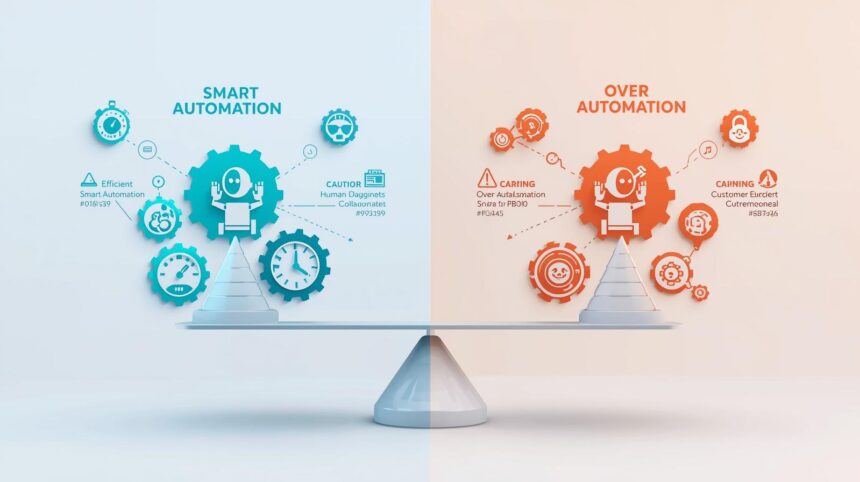
Organizations implement automation to achieve efficiency gains, but often do so indiscriminately, creating rigidity and customer dissatisfaction. Understanding the difference between smart automation and over-automation prevents implementations that reduce effectiveness despite technical success.
- Defining Smart Automation and Over-Automation
- Core Characteristics of Smart Automation
- Eliminates Genuinely Repetitive Work
- Preserves Human Judgment at Critical Points
- Enhances Rather Than Replaces Customer Experience
- Maintains Flexibility for Exceptions
- Warning Signs of Over-Automation
- Customer Complaints About Impersonal Service
- Employees Working Around Automated Systems
- Lost Revenue from Automated Decision Errors
- Increased Operational Fragility
- Reduced Innovation and Improvement
- Relationship Building and Strategic Partnerships
- Creative and Strategic Work
- Sensitive Communications and Crisis Management
- Judgment Calls With Ethical Implications
- Framework for Deciding What to Automate
- Step 1: Evaluate Task Characteristics
- Step 2: Assess Human Value Addition
- Step 3: Consider Customer Experience Impact
- Step 4: Evaluate Risk and Consequence
- Step 5: Determine Optimal Human-Automation Balance
- Implementing Smart Automation Successfully
- Start With Clear Business Objectives
- Design for Flexibility and Exception Handling
- Maintain Human Oversight and Accountability
- Prioritize Customer and Employee Experience
- Build in Continuous Improvement Processes
- Common Over-Automation Mistakes
- Frequently Asked Questions
- Strategic Perspective on Automation Balance
To navigate the complexity between beneficial and excessive automation, this article examines characteristics that distinguish the two, identifies warning signs of over-automation, and provides a framework for determining what should and shouldn’t be automated. Imagine a day in the life of a manager who skillfully balances automation and human input. As the day begins, automated systems handle routine scheduling and data entry tasks, while the manager focuses on strategic plans and team collaborations. Suddenly, an unexpected issue arises; seamlessly, the manager switches from automation to human intervention, using judgment to resolve the situation effectively. By the end of the day, this harmonious interaction between human and machine optimizes both efficiency and job satisfaction. This scenario illustrates where automation adds value and where human involvement remains essential. Understanding these differences enhances your ability to implement effective automation strategies.
Defining Smart Automation and Over-Automation
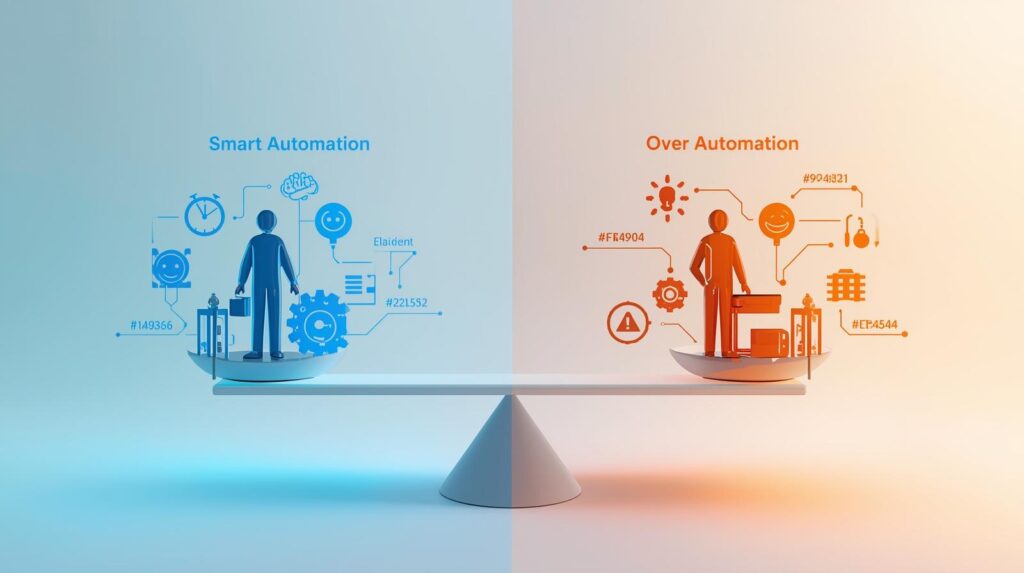
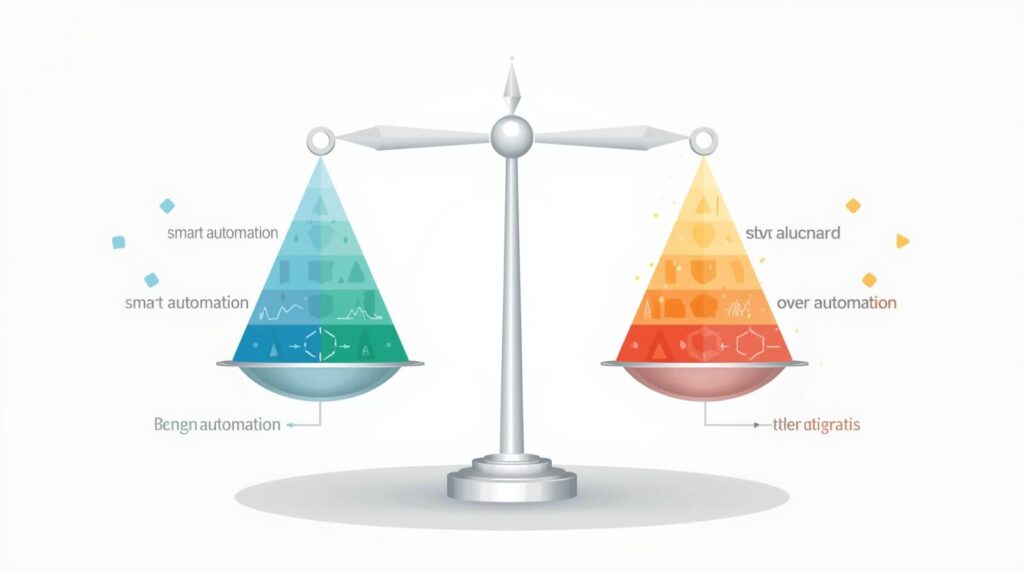
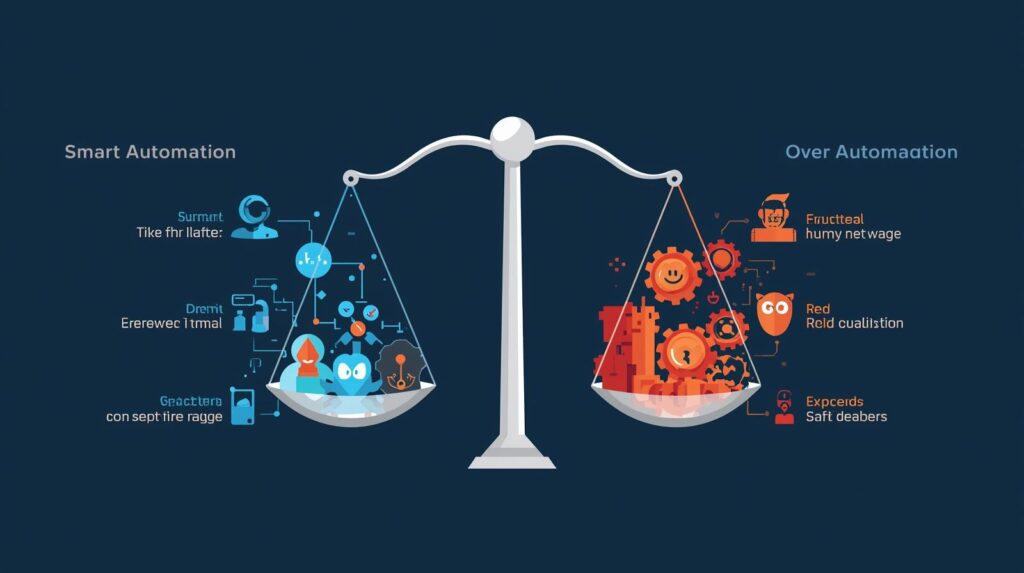
Smart automation removes repetitive work while preserving human judgment and flexibility where it matters most, assigning tasks that are better suited to systems to improve outcomes.
Over-automation removes human involvement from processes that benefit from judgment, creativity, or personal connection. It prioritizes efficiency metrics over effectiveness, resulting in technically successful systems that fail to meet actual business needs.
Appropriateness, not automation volume, matters. A comprehensive understanding of ‘Efficiency vs. Effectiveness’ tensions is crucial to prevent the pitfalls of over-relying on automation volume as a compass for decision-making. To illustrate, consider the decision trade-offs where extensive automation might streamline operations but at the cost of diminishing personalized customer interactions. Prioritizing effectiveness ensures that automation implementations align with business goals beyond mere cost savings. Extensive automation can avoid problems when processes are chosen carefully; automating the wrong processes can easily lead to over-automation.
Smart automation recognizes that some inefficiency serves valuable purposes. Moments that require thought, relationship-building, or creative problem-solving shouldn’t be optimized away, even with automation.
Core Characteristics of Smart Automation
Eliminates Genuinely Repetitive Work
Smart automation targets tasks that humans perform identically each time without meaningful decisions or customization. Data entry, file transfers, scheduled reporting, and status updates are ideal candidates for automation.
These tasks consume time without utilizing human capabilities. Automating them frees people to do work that requires judgment and creativity that systems cannot replicate.
The work itself provides no satisfaction or skill development for the humans who perform it. Removing these tasks improves job satisfaction while increasing productivity.
Consistency improves through automation of truly repetitive processes. Systems execute identical steps without variation caused by fatigue, distraction, or interpretation differences.
Preserves Human Judgment at Critical Points
Smart automation maintains human decision-making when judgment significantly affects outcomes. Approval workflows, exception handling, and strategic decisions remain human responsibilities.
Decision points that require contextual understanding, ethical considerations, or relationship factors shouldn’t be automated, even when technically possible. Systems lack the nuanced judgment humans apply in complex situations.
Escalation routes edge cases to people. Smart automation knows its limits and seeks human help for abnormal scenarios.
Overrides let humans overrule automation when needed. Systems should support, not restrict, human judgment.
Enhances Rather Than Replaces Customer Experience
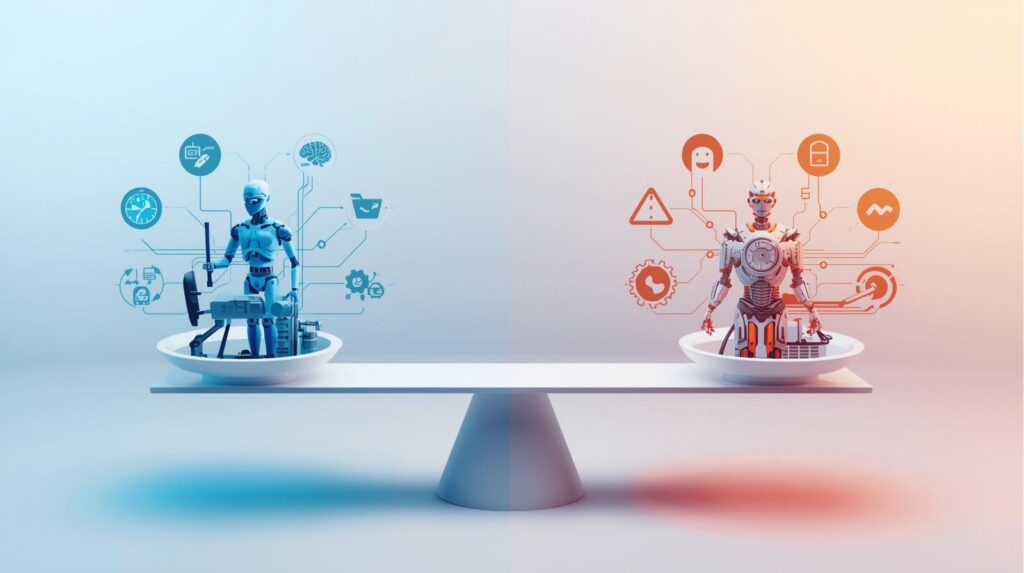
Smart automation improves customer interactions by efficiently managing routine inquiries and directing more complex issues to the appropriate personnel. Imagine mapping out a customer journey where you sketch one client interaction. By marking each moment as a “bot” or “human” interaction, you’ll gain insight into how smart automation can streamline processes and enhance the overall experience. This exercise transforms theory into practice, helping you immediately apply the concepts discussed. Difference Between Smart Automation vs Over-Automation
Speed matters for straightforward questions with clear answers. Customers appreciate immediate responses when asking about business hours, order status, or basic product information.
Personal attention matters for complex issues, complaints, and major decisions. Smart automation routes these to humans.
Customer choice determines interaction mode. Offering both automated and human options respects different preferences and situation requirements.
Maintains Flexibility for Exceptions
- Smart automation handles exceptions smoothly. Flexible processes handle unusual situations without breaking or resorting to workarounds.
- Rigid automation that can’t adapt to small changes creates more work than it saves, as staff work around inflexible systems.
- Exception handling procedures define how automation responds to situations outside normal parameters. Well-designed systems have clear paths for managing exceptions rather than failing completely.
- Easy modifications allow automation to be adjusted as business needs evolve. Smart systems adapt to changing requirements without requiring complete rebuilding.
- Includes Appropriate Monitoring and Oversight
Smart automation ensures visibility and intervention capability, preventing systems from becoming uncontrolled black boxes.
Performance monitoring tracks whether automation achieves intended outcomes. Metrics focus on business results rather than just technical operations.
Error detection and alerting notify relevant people when automation encounters problems. Issues get addressed before they cause a significant business impact.
Regular review ensures that automation continues to serve current business needs. What worked initially may need adjustment as circumstances change.
Warning Signs of Over-Automation
Customer Complaints About Impersonal Service
Customers expressing frustration with the inability to reach humans or feeling treated generically indicate that automation has replaced necessary personal interaction.
Generic responses to specific questions frustrate customers seeking relevant help. Over-automated systems prioritize efficiency over actually addressing customer needs.
Hard-to-reach human support damages relationships. Some situations always need personal attention.
Decreased customer satisfaction scores despite faster response times suggest that automation optimizes the wrong metrics. Speed without effectiveness harms more than it helps.
Employees Working Around Automated Systems
Manual workarounds show automation doesn’t fit real workflows. When automation increases work, over-automation has occurred. Consider the experience of a frontline employee in customer support who found herself overwhelmed by the rigid automated system that dictated responses. To accommodate nuanced customer queries, she created a personal spreadsheet to better track and manage specific client requests, something the automated system couldn’t handle efficiently. This workaround not only highlighted the system’s shortcomings but also underscored the creativity and adaptability of staff along with the friction over-automation can cause.
Too much time on exception handling means automation misses real-world complexity.
Decreased employee satisfaction relates to frustration with inflexible systems that prevent doing good work. Over-automation constrains rather than enables effective performance.
Lost Revenue from Automated Decision Errors
Automated systems making poor decisions without human review indicate over-automation of judgment-dependent processes.
False rejections happen when automation lacks context. Credit, fraud, and eligibility decisions need human judgment as well as efficiency.
Missed opportunities happen when rigid automation cannot recognize situations outside programmed parameters. Sales, partnerships, and customer retention often require flexibility that automated systems don’t provide.
Competitive disadvantage emerges when competitors offer more personalized or responsive service. Over-automation that prioritizes internal efficiency over customer experience damages market position.
Increased Operational Fragility
Over-automated systems create dependencies in which technical failures disrupt entire operations because humans no longer know how to perform the underlying processes manually.
Single points of failure emerge when automation removes redundancies. Organizations lose resilience without backup capabilities.
Outages reveal gaps: staff can’t operate manually if process knowledge is lost.
Recovery time lengthens because fixing automation requires technical expertise that is scarce in most organizations. Simple problems that humans could resolve directly become extended outages.
Reduced Innovation and Improvement
Over-automated processes can’t adapt to change. Workflows become rigid despite evolving business needs.
Process improvement stalls when changes need technical help. Frontline staff can’t implement fixes themselves.
Experimentation drops because updating automation is complex. Over-automation blocks the iteration needed for improvement.
Organizational learning suffers when automation removes people from processes. Insights gained through direct experience don’t emerge when systems handle certain processes. Certain processes should remain human-driven to preserve problem-solving and adaptability. The sections that follow illustrate situations where human involvement is critical, starting with complex problem solving and troubleshooting.ubleshooting
Situations that require analyzing multiple factors, developing creative solutions, and making contextual judgments require human involvement regardless of automation capabilities.
Customer issues lacking precedents require investigation and custom solutions. Automated trees can’t cover every scenario or create new ones.
Technical troubleshooting often means forming and testing hypotheses. Linear automation struggles with this iterative process.
Conflict resolution between parties requires understanding perspectives, finding acceptable compromises, and maintaining relationships. These fundamentally human activities don’t lend themselves to automation.
Relationship Building and Strategic Partnerships
Business relationships develop through personal interaction, trust building, and mutual understanding that automation cannot replicate.
Key account management requires understanding customer business contexts, anticipating needs, and positioning your organization as a strategic partner. These activities demand genuine human engagement.
Partnership negotiations involve reading nuance, understanding motivations, and finding creative arrangements that satisfy both parties. Automated processes cannot navigate these complex dynamics.
Networking and business development depend on authentic connections. Over-automating outreach creates generic interactions that fail to build meaningful relationships.
Creative and Strategic Work
Activities requiring imagination, innovation, and strategic thinking remain distinctly human capabilities that automation should support rather than replace.
Content strategy, brand positioning, and creative direction need human insight into audience psychology, cultural context, and competitive dynamics. Automation can support execution, but shouldn’t drive strategic creative decisions.
Product development benefits from automation in testing and analysis, but requires human vision to identify unmet needs and imagine new solutions.
Strategic planning combines data analysis with judgment about future scenarios, competitive moves, and organizational capabilities. While automation provides inputs, humans must make strategic choices.
Sensitive Communications and Crisis Management
High-stakes communications requiring empathy, careful messaging, and relationship preservation should remain human responsibilities.
Customer complaints and service failures need genuine acknowledgment and personalized resolution. Automated responses to problems feel dismissive regardless of technical sophistication.
Crisis communications require judging tone, timing, and messaging based on rapidly evolving situations. Automation lacks the contextual awareness these situations demand.
Difficult conversations with employees, partners, or stakeholders need human judgment about approach, timing, and follow-up. Automated handling of sensitive topics damages relationships.
Judgment Calls With Ethical Implications
Decisions affecting people’s lives, livelihoods, or well-being should retain human judgment even when automation is technically feasible.
Hiring decisions involve evaluating fit, potential, and human factors beyond resume screening. Over-automating hiring removes important judgment from significant life decisions.
Credit and lending determinations affect financial well-being. While automation supports evaluation, human review ensures fairness and considers circumstances that automated systems miss.
Healthcare decisions require weighing treatment options, understanding patient preferences, and applying medical judgment to individual situations. Automation assists but shouldn’t determine care.

Framework for Deciding What to Automate
Step 1: Evaluate Task Characteristics
Assess whether tasks are genuinely suited to automation by systematically examining their nature and requirements.
Repetitiveness: Does the task involve identical steps each time? High repetition favors automation.
Rule-based logic: Can decision points be expressed as clear rules? Ambiguous judgment suggests keeping human involvement.
Volume: How frequently does this occur? High-volume tasks justify automation investment more than occasional activities.
Complexity: Does the task require synthesizing multiple factors or following simple sequential steps? Complexity indicates human judgment may be necessary.
Creativity requirement: Does the work involve novel problem-solving or applying standard procedures? Creative work shouldn’t be automated.
Step 2: Assess Human Value Addition
Determine what humans contribute that automation cannot replicate.
Judgment quality: Do humans make better decisions than rules-based systems for this task? If yes, maintain human involvement.
Relationship impact: Does personal interaction during this task build trust or strengthen relationships? Relationship-building activities should remain human-driven.
Learning opportunity: Does performing this task develop important skills or understanding? Tasks that build capability may warrant human involvement, even if they are automatable.
Satisfaction and engagement: Do people find this work meaningful or purely tedious? Automating tedious work improves morale, while automating engaging work reduces it.
Step 3: Consider Customer Experience Impact
Evaluate how automation affects customer perception and satisfaction.
Response expectations: Do customers expect an immediate response, or are they willing to wait for personalized attention? Different scenarios have different automation suitability.
Issue complexity: Are customer needs typically straightforward or nuanced? Complex needs require human handling.
Relationship importance: Are these transactional interactions or relationship-building moments? High-value relationships need personal attention.
Recovery capability: When automation fails to meet needs, can customers easily escalate to human support? Difficult escalation paths frustrate customers.
Step 4: Evaluate Risk and Consequence
Consider potential negative outcomes if automation performs poorly or fails entirely.
Error cost: What happens if the automated system makes mistakes? High-cost errors suggest maintaining human oversight.
Reversibility: Can automated actions be easily undone if incorrect? Irreversible decisions need human verification.
Compliance requirements: Do regulatory or legal obligations require human involvement? Certain decisions may legally require human judgment.
Reputation impact: Would visible automation errors damage brand perception? Customer-facing automation carries reputation risk.
Step 5: Determine Optimal Human-Automation Balance
Design systems that combine automation efficiency with human judgment rather than choosing purely automated or manual approaches. Introduce a ‘co-pilot mode’ where automation assists but does not fully replace human involvement, fostering a balanced approach. This hybrid archetype encourages readers to replicate it, ensuring that technology complements, rather than replaces, human decision-making.
Automation with review: Systems execute routine cases automatically while routing exceptions to humans for review.
Human-initiated automation: People decide when to trigger automation rather than automation running entirely independently.
Automated assistance: Systems provide information and recommendations while humans make final decisions.
Fallback capability: Maintain manual processes as backup when automation fails or encounters unusual situations.
Implementing Smart Automation Successfully
Start With Clear Business Objectives
Define what you want automation to achieve beyond generic efficiency improvements. Specific goals guide appropriate implementation.
Measurable outcomes, such as “reduce invoice processing time from 3 days to 4 hours,” provide clearer direction than vague efficiency goals.
Business results matter more than automation metrics. Focus on customer satisfaction, revenue impact, and error reduction rather than the percentage of tasks automated.
Stakeholder input ensures automation addresses real problems rather than creating solutions to problems that do not exist. Involve people who currently perform planning processes in the automation planning.
Design for Flexibility and Exception Handling
Build automation that handles common cases efficiently while gracefully handling exceptions, rather than optimizing only for the most common scenarios.
Exception paths route unusual situations to appropriate handling without system failure. Well-designed automation knows its limitations and requests help when needed.
Override mechanisms allow humans to intervene when circumstances warrant a different course of action. Smart systems support human judgment rather than constraining it.
Easy modification enables adjusting automation as requirements evolve. Avoid rigid systems requiring extensive technical work to accommodate minor changes.
Maintain Human Oversight and Accountability
Establish clear responsibility for automated system performance and decisions rather than treating automation as set-and-forget technology.
Designated owners monitor system performance, respond to issues, and coordinate improvements. Automation without accountable owners deteriorates over time.
Regular review cycles assess whether automation continues to serve its intended purposes. What worked initially may need adjustment as the business evolves.
Performance visibility enables intervention before small problems become significant issues. Transparent operations prevent automation from becoming uncontrolled black boxes.
Prioritize Customer and Employee Experience
Evaluate automation success through its impact on people who interact with systems rather than purely technical metrics. Implement balanced metrics that consider both technical performance and user experience sentiment indicators. For instance, pairing Net Promoter Score (NPS) with metrics like ‘first-contact resolution’ can provide valuable insights, offering a dual lens on success. This approach encourages a more comprehensive understanding of how automation affects service experience. Customer feedback reveals whether automation improves or degrades the experience. Satisfaction scores, complaint patterns, and direct feedback guide refinement.
Employee input identifies where automation helps and where it hinders actual work. Frontline staff understand the impact of automation better than executives reviewing dashboards.
Experience metrics like ease of use, frustration incidents, and support escalations matter as much as efficiency measurements.
Build in Continuous Improvement Processes
Treat automation as evolving systems that require ongoing refinement rather than as complete projects.
Performance monitoring tracks actual outcomes against intended results. Regular measurement identifies improvement opportunities.
Feedback loops capture insights from humans interacting with automation. Customer input, employee observations, and support tickets reveal where systems need adjustment.
Iterative enhancement makes incremental improvements based on real-world experience rather than attempting a perfect initial design.
Common Over-Automation Mistakes
Organizations frequently automate customer-facing interactions too extensively, removing the personal connection that customers value. They optimize response time without considering response quality or the impact on the relationship.
Many businesses eliminate human involvement from processes that require judgment because automation is technically feasible. Technical capability doesn’t equal business appropriateness.
Some companies automate without establishing proper exception handling. They design for the 80% common cases while creating terrible experiences for the 20% of situations that don’t fit.
Others implement automation without maintaining fallback capabilities. When systems fail, operations halt completely because manual alternatives no longer exist.
Businesses often measure automation success solely through efficiency metrics, ignoring customer satisfaction, employee morale, and strategic outcomes. Optimizing wrong metrics produces counterproductive results.
Many organizations fail to monitor automated systems adequately after implementation. They assume automation continues working effectively without ongoing verification.
Frequently Asked Questions
How do you know if you’ve automated too much?
Key indicators include customer complaints about difficulty reaching humans, employees creating workarounds to bypass automation, declining satisfaction despite faster processes, and lost business from inflexible automated decisions. If automation optimizes efficiency while reducing effectiveness, you’ve likely over-automated. Regular surveys of customers and employees reveal whether automation enhances or detracts from their experience.
What percentage of business processes should be automated?
No universal percentage exists because appropriate automation depends on process characteristics rather than arbitrary targets. Focus on automating high-volume, repetitive, rule-based tasks while maintaining human involvement in judgment-dependent, relationship-building, and creative work. Some organizations appropriately automate 70% of processes, while others should automate only 20%. Process suitability matters more than automation percentage.
Can you reverse over-automation once implemented?
Yes, but requires deliberate effort to thoughtfully reintroduce human involvement. Start by identifying processes where automation creates problems rather than solutions. Gradually add human touchpoints at critical decision moments while maintaining automation for genuinely repetitive tasks. Retraining staff on manual processes may be necessary when automation has eliminated institutional knowledge. Reversal requires investment but prevents ongoing damage from inappropriate automation.
How do you balance efficiency gains with maintaining human connection?
Design hybrid approaches where automation handles routine elements while humans engage at relationship-critical moments. Automate administrative tasks, freeing people for meaningful interactions rather than automating the interactions themselves. Allow customers to choose between automated and human service based on their needs and preferences. Measure both efficiency and relationship quality to ensure balance rather than optimizing efficiency alone.
What should we automate first when starting automation initiatives?
Begin with high-volume, repetitive administrative tasks that nobody enjoys performing—data entry, file transfers, scheduled reporting, and status updates. These provide clear efficiency gains without risking customer relationships or removing valuable human judgment. Success with straightforward automation builds confidence and funding for more sophisticated projects. Avoid automating customer-facing or judgment-dependent processes until you’ve established automation capabilities with lower-risk implementations.
Strategic Perspective on Automation Balance
Smart automation enhances human capabilities rather than replacing human involvement indiscriminately. Organizations achieving best results view automation as enabling people to focus on higher-value work rather than eliminating people from processes.
The goal isn’t maximizing automation percentage but optimizing business outcomes. Sometimes, more automation improves results. Other times, maintaining or even increasing human involvement drives better performance despite lower efficiency metrics.
Successful organizations continuously evaluate whether automation serves its intended purposes. They monitor impacts on customers, employees, and business results rather than assuming automation remains beneficial once implemented.
The distinction between smart automation and over-automation ultimately reflects whether technology serves business strategy or has become the strategy. Smart automation supports human judgment, creativity, and relationships that drive business success. Over-automation sacrifices these essential elements in pursuit of efficiency alone.
Implement automation thoughtfully based on a clear understanding of what automation does well and where human involvement remains essential. This balanced approach delivers sustainable benefits rather than short-term efficiency gains that undermine long-term effectiveness.