
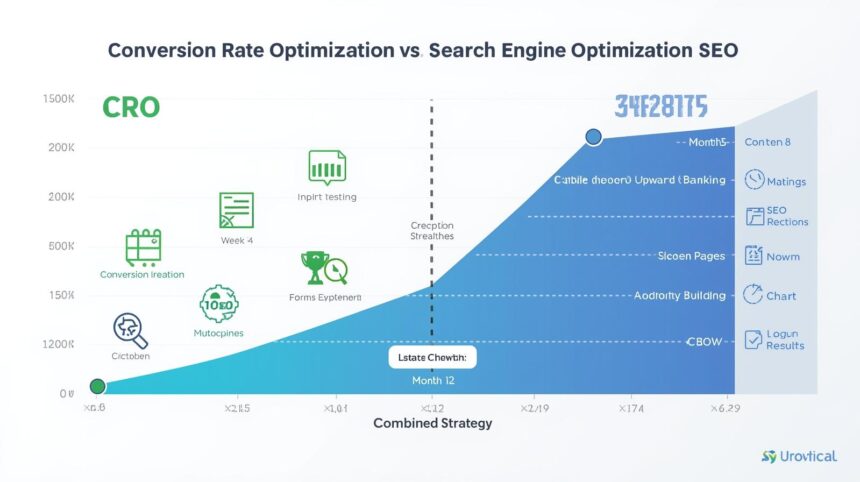
If you’re losing sleep over marketing challenges, you are not alone. Businesses are often caught between a rock and a hard place, choosing between stagnant site traffic and the wastage of precious advertising dollars. For businesses with limited marketing budgets, the crucial question is: should you focus on attracting more traffic through search engine optimization, or on converting the visitors you already have with conversion rate optimization? Understanding the growth potential of CRO vs. SEO provides clarity on which strategy can deliver faster, more effective results tailored to your specific needs.
- Timeline to See Results: CRO vs SEO
- Cost Analysis: Investment Requirements
- When CRO Drives Faster Growth
- High Traffic, Low Conversion Scenarios
- Short-Term Revenue Pressure
- Mature Markets and Content Saturation
- When SEO Drives Faster Growth
- Low Traffic, Reasonable Conversion Scenarios
- Long-Term Sustainable Growth Priorities
- Competitive Positioning Opportunities
- Decision Framework: CRO vs SEO Priority
- Step 1: Assess Current Traffic and Conversion Baseline
- Step 2: Calculate Improvement Potential
- Step 3: Evaluate Resource Constraints
- Step 4: Consider Market Dynamics
- Step 5: Make Initial Allocation Decision
- The Compounding Effect of Combined Strategies
- Limitations and Risks of Each Approach
- Avoiding Common Pitfalls in Choosing Between CRO and SEO
- Frequently Asked Questions
- Strategic Approach to CRO vs SEO Priority
This article explores the distinct roles of CRO and SEO, guiding you toward the quickest path to growth based on your specific business metrics and goals. CRO enhances the percentage of visitors taking desired actions such as purchases or sign-ups, boosting revenue without needing new visitors. Meanwhile, SEO increases visibility and audience reach through improved search rankings.
Search engine optimization improves visibility in search results, bringing more qualified visitors. SEO expands your audience by boosting rankings for relevant queries.
Both strategies drive revenue growth, but through distinct methods. SEO increases the potential number of site visitors, while CRO amplifies the impact of each visit.
The growth impact from each depends on your baseline metrics. A site converting 1% of 10,000 monthly visitors generates 100 conversions. (How to Integrate SEO and CRO for More Traffic and Conversions, 2024) Consider Client X, who, by applying targeted CRO strategies, saw their conversion rate double from 1% to 2% within 30 days, thereby boosting revenue significantly. Doubling the conversion rate to 2% or doubling the traffic to 20,000 both yield 200 conversions, but through entirely different approaches.
Timeline to See Results: CRO vs SEO
CRO Implementation and Impact Speed
Conversion rate optimization typically shows measurable results within 4-8 weeks once improvements are implemented and tested. Think of each CRO initiative as part of a ‘build-measure-learn’ cycle, where each phase compounds insight and fosters ongoing improvements. By structuring these as learning loops, teams can quickly refine hypotheses and speed up iterations, providing a reassuring path to leaders wary of continual experimentation.
A/B testing and validation are the main timeline factors. Statistically significant results require enough traffic and 2-4 weeks per test.
Quick wins can come from removing friction points. Fixing a broken checkout, improving mobile usability, or clarifying elements can deliver immediate results.
Improvements add up as optimizations stack. Each test raises performance, enabling further gains from the next round.
SEO Implementation and Impact Speed
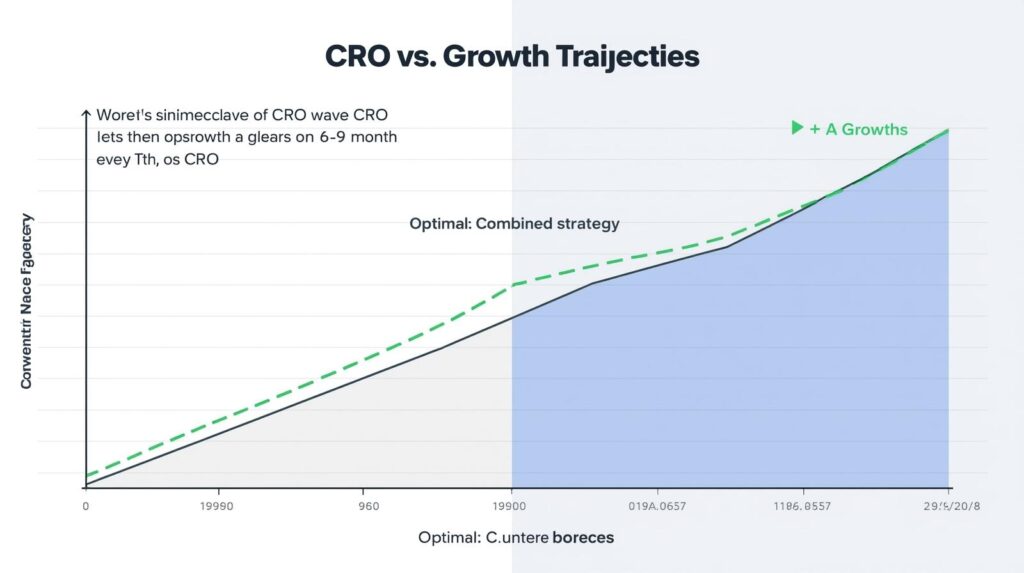
- Search engine optimization typically takes a variable period to show significant traffic increases. Early improvements in traffic are usually observed within a 3–6 month timeframe, while reaching full traffic maturity can take from 9 to 12 months. This range accounts for variations in market conditions and competition.
- Content and technical updates take time. Search engines must discover, index, and evaluate new content before rankings change.
- Authority builds through gradual link acquisition. Earning quality backlinks requires sustained outreach, content, and relationships over months.
- Outranking established competitors is slow. Superior, relevant content and sustained effort are required over long periods.
- Algorithm updates affect timing. Major ranking changes often coincide with unpredictable updates during the year.
Comparing Realistic Timelines
CRO delivers faster initial results when you have existing traffic to optimize. The first month of focused CRO work often produces measurable conversion improvements. For instance, one company experiencedan impressive conversion increase of 30% after implementing a targeted A/B test within just four weeks. This tangible outcome demonstrates how targeted CRO strategies can quickly boost conversion rates and dispel doubts about their effectiveness.
SEO requires patience and sustained investment before showing returns. The first three months typically show minimal traffic increase regardless of optimization quality.
Break-even timing generally favors CRO for quick results, making it preferable for businesses under short-term performance pressure.
For long-term growth, focus on SEO. Once rankings are established, traffic continues with less incremental investment—a key consideration for strategic decision-making.
Cost Analysis: Investment Requirements
CRO Investment Structure
Conversion rate optimization requires testing platform subscriptions, design and development resources, and analytical capabilities to identify opportunities and implement changes.
Testing platforms cost $50-$500 monthly, depending on traffic and features. Enterprise solutions cost more than $1,000 per month.
Design and development are the main variable costs. Simple copy changes need little investment; redesigns demand more resources.
Internal resources must analyze data, identify opportunities, and manage testing programs.
Total monthly investment for effective CRO programs ranges from $2,000 to $10,000, depending on organization size, testing velocity, and whether work is handled internally or through agencies. To add clarity, it’s helpful to break down this investment into key components: testing tools, creative design work, and data analysis. Testing tools often require subscriptions that vary by features, while creative and design tasks demand resources for developing and implementing changes. Finally, data analysis is crucial for gaining insights and fueling future optimization cycles, reinforcing the idea that this investment serves as fuel for validated learning. This approach helps streamline budget discussions by aligning costs with learning and expected outcomes.
SEO Investment Structure
Some parts of this text have been detected as AI-generated. Search engine optimization requires content creation, technical development, link-building efforts, and ongoing optimization across multiple areas.
Content production represents an ongoing expense. Creating comprehensive, high-quality content that ranks requires research, writing, editing, and design—typically $500-2,000 per piece depending on depth and quality.
Technical SEO work includes site speed optimization, mobile improvements, structured data implementation, and resolving crawl issues. One-time technical audits and fixes cost $3,000-15,000 while ongoing maintenance requires monthly attention.
Link building requires outreach, relationship development, and often content creation to earn backlinks. Effective programs require $1,000-$5,000 in monthly labor and resources.
Total monthly investment for competitive SEO programs ranges from $3,000 to $15,000, depending on market competitiveness, current site authority, and content production requirements. For smaller players, there exists a unique opportunity to target specific, underserved queries that incumbents might overlook. By focusing on these ‘jobs to be done’ gaps, smaller businesses can effectively allocate their strategic budgets to maximize SEO returns sooner, turning budget size from a constraint into an advantage.
ROI Comparison by Timeframe
Three-month ROI typically favors CRO when you have sufficient existing traffic. Converting 3% of 10,000 monthly visitors instead of 2% generates 100 additional conversions immediately.
After six months, CRO often stays ahead early on, while SEO starts contributing as traffic grows. The crossover depends on traffic volume and the rate of conversion improvement.
Twelve-month ROI frequently shows SEO producing higher absolute returns as compounding traffic growth outpaces percentage conversion improvements. A site that doubles traffic through SEO while maintaining conversion rates generates more revenue than one that doubles conversion rate with stable traffic.
SEO creates long-term value, with rankings and authority providing ongoing traffic, while CRO improvements benefit only current visitors.
When CRO Drives Faster Growth
High Traffic, Low Conversion Scenarios
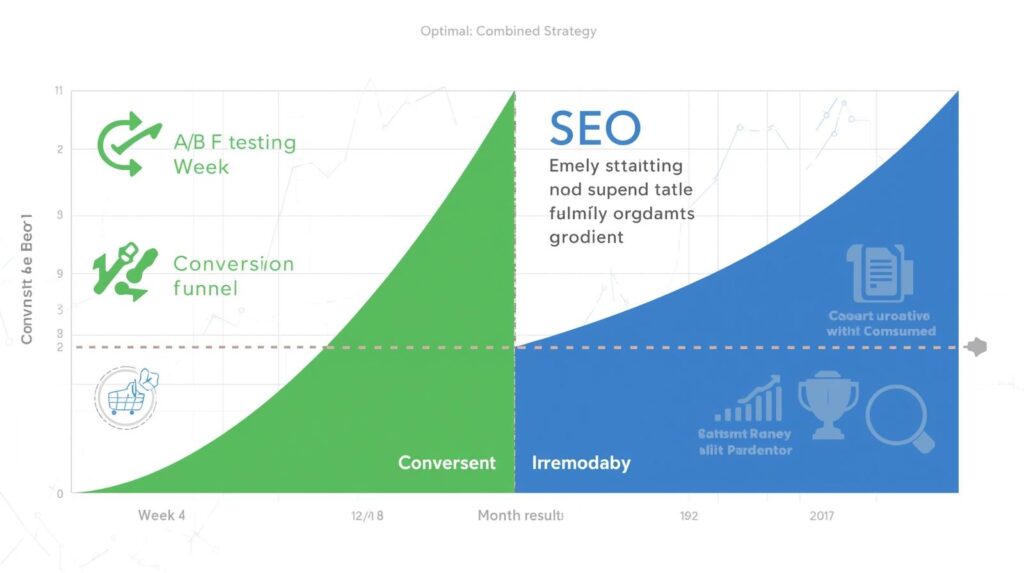
Businesses that already generate substantial traffic but convert poorly see immediate impact from conversion optimization.
Sites with high traffic but low conversion rates gain more from improving conversion rates than from targeting modest traffic boosts.
E-commerce sites with abandoned cart rates above 70% benefit dramatically from checkout optimization. Reducing abandonment by even 10 percentage points translates directly to revenue.
Lead generation sites with high form abandonment rates gain immediate value from form optimization. Simplifying multi-step forms or reducing the number of required fields often doubles completion rates.
Short-Term Revenue Pressure
Organizations that need to demonstrate results quickly find CROs’ faster timelines advantageous for meeting near-term objectives.
Quarterly performance cycles favor CRO’s 4-8 week impact over SEO’s 3-6 month timeline. Improvement in the current quarter justifies continued investment.
Investor expectations for growth metrics make CRO attractive when demonstrating traction quickly matters more than long-term efficiency.
Seasonal businesses benefit from CRO improvements that capture immediate traffic during peak seasons rather than waiting months for SEO traffic growth.
Mature Markets and Content Saturation
Industries where ranking organically has become extremely difficult due to established competitors and saturated content make CRO a more viable growth path.
Highly competitive keywords requiring years of sustained SEO investment to rank make conversion optimization more attractive for faster returns.
Niches dominated by major brands with massive content and authority budgets leave little organic opportunity for smaller players, regardless of SEO investment.
In markets where paid advertising drives most traffic, organic growth takes a back seat to optimizing conversion rates for paid traffic sources.
When SEO Drives Faster Growth
Low Traffic, Reasonable Conversion Scenarios
Businesses with strong conversion rates but limited traffic benefit more from increasing audience through SEO than from minor conversion gains.
Sites converting 3-5% of limited traffic have already been well optimized. Doubling 5,000 monthly visitors produces more growth than improving conversion from 4% to 5%.
New websites starting with zero organic presence benefit more from establishing visibility than from optimizing conversions of traffic they don’t yet have.
Businesses in growing markets where search demand exceeds content supply can capture traffic relatively quickly through focused SEO efforts.
Long-Term Sustainable Growth Priorities
Organizations that prioritize sustainable, efficient customer acquisition over immediate results find that SEO’s compounding returns better align with their strategic objectives.
Reducing customer acquisition costs over time favors SEO’s increasing efficiency, as organic traffic grows without proportional increases in costs.
Building brand authority and market presence happens through visibility in search results. SEO creates ongoing brand exposure beyond immediate conversions.
Investor preference for scalable, efficient growth channels makes SEO attractive despite a longer timeline to initial results.
Competitive Positioning Opportunities
Markets where competitors neglect SEO, or where gaps exist in search result coverage, create opportunities for faster-than-typical SEO results.
Emerging topics with limited existing content allow newer sites to rank relatively quickly before competition intensifies.
Local SEO opportunities in underserved geographic markets generate results faster than national competitive landscapes.
Long-tail keyword strategies targeting specific, less competitive queries deliver quicker wins than ranking for highly competitive primary terms.
Decision Framework: CRO vs SEO Priority
Step 1: Assess Current Traffic and Conversion Baseline
Calculate your current performance to determine which optimization approach offers more growth potential. Use a “North Star” metric, such as revenue per visitor, to guide your assessment. This will help focus efforts on outcomes that drive business success rather than getting caught up in vanity numbers.
Traffic volume determines whether conversion optimization can generate meaningful absolute results. Sites with less than 5,000 monthly visitors may find conversion improvements produce a negligible revenue impact.
Current conversion rate reveals optimization potential. Sites converting below 2% have substantial room for improvement, while those above 5% may have limited additional optimization opportunities.
Industry benchmarks provide context for evaluating performance. Compare your metrics to typical ranges for your business model to identify whether traffic or conversion represents the bigger gap.
Step 2: Calculate Improvement Potential
Estimate realistic gains from each strategy to project potential impact.
CRO potential calculation: Identify the current conversion rate and estimate the achievable improvement. Doubling conversion rates is unrealistic, but 20-50% relative improvement is achievable for most sites through systematic optimization.
SEO potential calculation: Research search volume for relevant keywords and estimate ranking probability. Calculate potential traffic from target rankings using typical click-through rates for each position.
Compare absolute conversion volume increases from each approach. Multiply current visitors by improved conversion rate for CRO impact. Multiply increased traffic by the current conversion rate for SEO impact.
Step 3: Evaluate Resource Constraints
Consider available budget, expertise, and timeline in determining which strategy is feasible.
Budget limitations may favor one approach. CRO typically requires less total investment than competitive SEO programs.
Internal expertise availability matters significantly. CRO needs analytical and testing capabilities, while SEO requires content creation and technical optimization skills.
Timeline constraints determine strategy viability. Organizations needing results within one quarter should prioritize CRO given SEO’s longer timeline.
Step 4: Consider Market Dynamics
Assess the competitive landscape and market conditions affecting each strategy’s potential effectiveness.
Search competitiveness research reveals how difficult organic ranking will be. Highly competitive markets may make CRO a better investment than multi-year SEO campaigns.
Content saturation analysis identifies whether gaps exist in search results. Markets with minimal quality content offer SEO opportunities, while saturated markets favor CRO.
Paid advertising reliance in your industry affects organic potential. If competitors primarily use paid channels, the organic opportunity may be substantial.
Step 5: Make Initial Allocation Decision
Determine primary focus while maintaining some investment in both areas when possible.
The primary strategy receives 70-80% of the optimization budget and resources. This concentrated investment enables achieving meaningful results rather than spreading resources too thin.
The secondary strategy maintains a 20-30% allocation to begin building capabilities and testing potential. This prevents neglecting one area entirely while focusing on the other.
Reassessment intervals should occur quarterly. Evaluate results and adjust allocation based on which strategy is performing better than expected.
The Compounding Effect of Combined Strategies
How CRO and SEO Amplify Each Other
Optimizing both dimensions creates a multiplicative rather than an additive impact on business growth.
- Higher conversion rates increase SEO ROI by extracting more value from organic traffic. A site that converts 4% of organic visitors generates twice the revenue from the same SEO investment as one that converts 2%.
- Improved user engagement from CRO work sends positive signals to search engines. Lower bounce rates, longer time on site, and higher page views per session correlate with better rankings.
- SEO-driven content creation provides inventory for CRO testing. New landing pages for different search queries create opportunities for conversion testing and optimization.
- CRO insights inform SEO content strategy. Understanding what messaging and value propositions convert best guides content creation for search traffic.
Phased Implementation Approach
Most businesses benefit from sequential focus rather than simultaneous equal investment in both strategies.
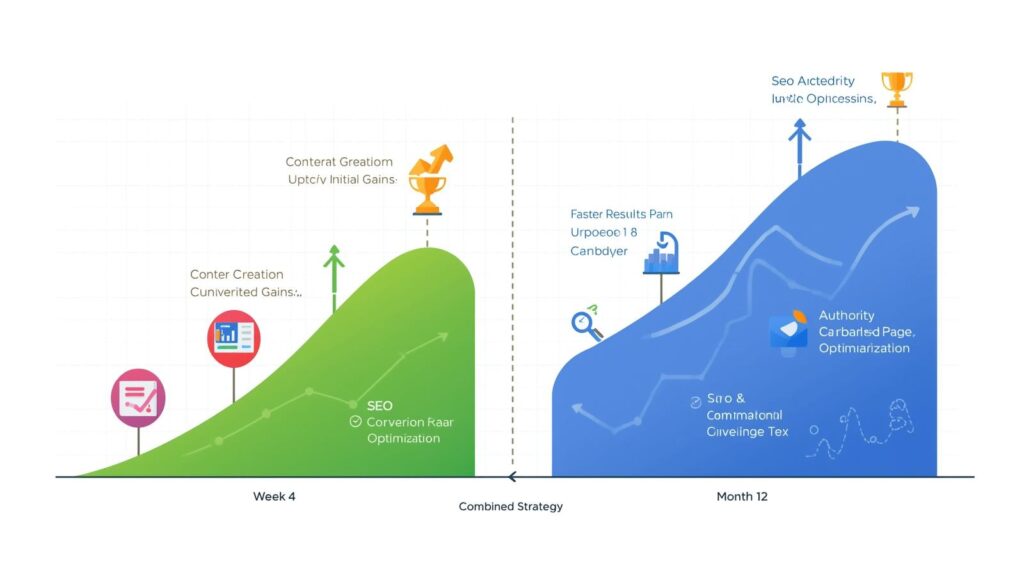
- Phase 1 (Months 1-3): Focus on quick-win CRO improvements while beginning SEO foundation work. Fix obvious conversion friction during SEO audits and keyword research.
- Phase 2 (Months 4-6): Shift toward SEO content production while maintaining the CRO testing program. Begin publishing optimized content as conversion improvements stabilize.
- Phase 3 (Months 7-12): Balance investment as SEO traffic begins materializing. Increased organic traffic provides better conditions for CRO testing.
- Phase 4 (Months 12+): Maintain an integrated program where SEO drives traffic growth, and CRO maximizes value from increasing visitor volume.
Resource Allocation Models
Different business situations warrant different approaches to balancing CRO and SEO investments.
- CRO-Primary Model (70/30): Businesses with existing traffic, near-term revenue pressure, or highly competitive SEO markets allocate the majority of resources to conversion optimization while maintaining basic SEO hygiene.
- SEO-Primary Model (70/30): Businesses with low traffic, strong conversion rates, or SEO opportunities allocate the majority of resources to organic growth while testing critical conversion elements.
- Balanced Model (50/50): Businesses with moderate traffic, room for improvement in both areas, and longer planning horizons distribute resources relatively evenly.
- Adaptive Model: Businesses shift their allocation quarterly based on performance data, allocating more to whichever strategy is producing better returns in current conditions.
Limitations and Risks of Each Approach
CRO Limitations and Diminishing Returns
Conversion rate optimization faces a ceiling effect, where additional testing yields smaller incremental improvements.
The maximum conversion potential varies by industry and business model, but typically plateaus between 3% and 8% for most e-commerce sites and lead-generation businesses.
Testing velocity slows as traffic divides across multiple test variations. Sites with limited traffic struggle to reach statistical significance for more than 1-2 simultaneous tests.
The winner’s curse occurs when test results overestimate the true improvement due to random variation. Projected gains don’t always materialize when winning variations deploy permanently.
Organizational test capacity limits the number of experiments that can run simultaneously. Design, development, and analytical resources constrain testing programs regardless of the quantity of opportunities.
SEO Limitations and Uncertainty
Search engine optimization faces algorithmic changes, competitive dynamics, and diminishing returns in saturated markets.
Algorithm updates can unpredictably dramatically affect rankings. Years of SEO work sometimes disappear overnight when search engines change ranking criteria.
Competitive response erodes advantages over time. As you rank better, competitors invest more in outranking you, creating ongoing effort requirements to maintain positions.
Content saturation reduces the ranking potential of newer content. Established content with years of authority often retains rankings even when newer, better content from competitors emerges.
Technical infrastructure limitations constrain SEO potential for some businesses. Sites on poor platforms or with fundamental technical issues struggle to rank regardless of content quality.
Combined Strategy Risks
Pursuing both strategies simultaneously risks spreading resources too thin to achieve meaningful results in either area.
Divided attention prevents the development of deep expertise in either discipline. Optimization requires specialized knowledge that comes from focused practice.
Budget constraints often force compromises that reduce the effectiveness of both programs. Inadequate investment in CRO testing or SEO content production yields poor returns.
Competing priorities create confusion about objectives and success metrics within the organization. Teams need clarity on primary goals to make effective daily decisions.
Avoiding Common Pitfalls in Choosing Between CRO and SEO
Transform potential errors into actionable strategies for growth by proactively addressing common challenges in selecting CRO or SEO. Use these empowering steps to guide your decision-making process:
1. Evaluate Your Expertise: Consider whether your knowledge and skills align with the chosen strategy. Leverage your strengths or seek help in areas where your understanding may be limited.
2. Customize Your Approach: Tailor your strategy to your unique business context instead of simply following competitors. Identify what specifically works for your business and adapt strategies accordingly.
3. Stay Flexible: Remain open to adjusting your focus as conditions change. Evaluate performance metrics regularly and shift priorities based on actual results to keep growing effectively.
4. Optimize Your Budget: Allocate resources strategically rather than equally. Ensure your investment truly impacts the chosen area, whether it’s CRO or SEO.
5. Prioritize Measurement: Develop robust analytics infrastructure to measure strategy effectiveness. Understand what drives your revenue and make informed decisions based on strong data.
6. Focus on What Matters: Recognize true performance metrics rather than getting distracted by vanity metrics. Prioritize efforts that enhance actual revenue and profiabilityn.
Frequently Asked Questions
Which strategy delivers faster revenue growth for most businesses?
CRO typically delivers faster initial revenue growth when you have 10,000+ monthly visitors, with measurable improvements within 4-8 weeks. SEO requires a minimum of 3-6 months before traffic increases materialize. However, specific circumstances, including current traffic volume, conversion rates, and market competitiveness, determine the optimal strategy for individual businesses. Sites with low traffic benefit more from SEO while high-traffic, low-conversion sites see better CRO returns.
Should small businesses focus on CRO or SEO with limited budgets?
Small businesses with an under $3,000 monthly optimization budget should typically prioritize SEO unless they already have substantial traffic. Building organic visibility creates sustainable traffic without ongoing advertising costs, while CRO only benefits traffic you’re already generating. However, businesses with existing traffic from other sources should allocate some budget to fixing obvious conversion friction before investing exclusively in traffic growth.
How much traffic do you need before CRO makes sense?
CRO becomes viable around 5,000 monthly visitors, with 10,000+ being ideal for effective testing. Lower traffic volumes take too long to reach statistical significance in A/B tests, making results unreliable. However, fixing obvious conversion problems doesn’t require testing—addressing clear friction points benefits traffic at any volume. Formal testing programs need sufficient volume to produce conclusive results within reasonable timeframes.
Can you run effective SEO and CRO programs simultaneously?
Yes, but requires a minimum budget of $5,000-7,000 monthly to fund both strategies adequately. Below this threshold, spreading resources produces mediocre results in both areas rather than strong performance in either. Most businesses benefit from sequential focus—addressing whichever area offers more immediate opportunity first, then expanding to the second strategy once initial gains stabilize.
How do you measure which strategy is working better?
Track revenue per visitor for CRO impact and total organic revenue for SEO impact, measuring each strategy’s contribution to overall revenue growth. Calculate the cost per acquisition for organic traffic versus optimizing existing traffic sources. Monitor both traffic volume and conversion rate trends over time, looking for inflection points where investment produces measurable improvement. Proper attribution tracking enables isolating each strategy’s specific revenue contribution.
Strategic Approach to CRO vs SEO Priority
The CRO vs SEO growth question lacks a universal answer because optimal strategy depends entirely on your specific baseline metrics, resources, and market position.
Businesses with substantial existing traffic that convert poorly see faster returns from CRO. Organizations with good conversion rates but insufficient traffic benefit more from SEO investment. Most businesses eventually need both, but should prioritize based on current bottlenecks.
Start by honestly assessing your situation through data rather than assumptions. Calculate actual improvement potential from each strategy based on realistic scenarios. Consider your competitive position, budget constraints, and timeline requirements.
Make an initial allocation decision favoring one strategy while maintaining some investment in the other. Reassess quarterly based on actual performance data rather than projecting indefinitely from initial assumptions.
Remember that growth compounds when both traffic and conversion rates improve simultaneously. The ultimate goal isn’t choosing between CRO and SEO, but determining the optimal sequence and allocation to achieve sustainable business growth through both channels over time.