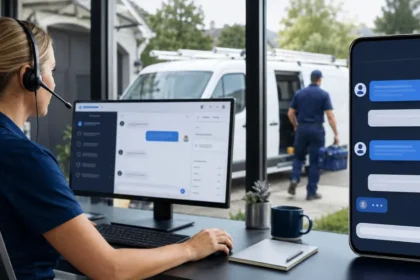

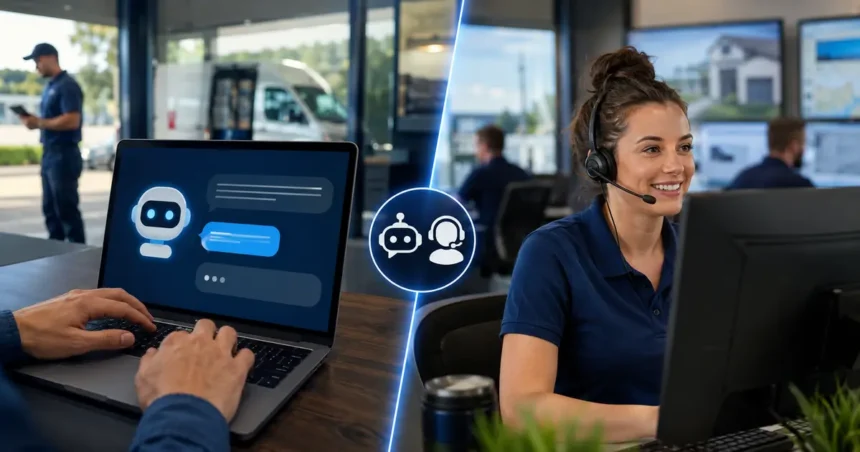
An AI chatbot and live chat solve different staffing problems. AI provides immediate, repeatable coverage at any hour; live chat provides judgment, reassurance and flexible problem-solving through a person. For most home service websites, the strongest setup is not an absolute choice. It is a designed handoff in which automation handles simple intake and people take over when context or trust matters.
- Quick answer
- Compare the outcome, not the label
- Where AI chat is stronger
- Where live chat is stronger
- Key tradeoffs
- Match the channel to visitor intent
- A practical hybrid design
- Staff live chat like an operational channel
- Control the AI knowledge and permissions
- Protect the website conversion path
- Compare total cost honestly
- Run a fair pilot
- Plan the handoff experience in detail
- Privacy and transparency
- When AI chat is the better first choice
- When live chat is the better first choice
- Frequently asked questions
- Does live chat convert better than an AI chatbot?
- Can AI transfer a chat to a person?
- Should we hide that the chatbot is AI?
- What should happen after hours?
- Can an outsourced live-chat service replace office staff?
- Is a hybrid system more expensive?
- Related Oivic guides
- Authoritative resources
- Design the handoff before buying either channel
Quick answer
Choose an AI chatbot for 24/7 answers, basic qualification and structured lead capture. Choose live chat for complex projects, complaints, negotiation and visitors who want a person. A hybrid model is usually best: AI covers defined questions and after-hours intake, while live agents receive the transcript and take over during staffed periods.
Compare the outcome, not the label
“AI chat” can mean a free-form generative assistant, a controlled decision tree or a combination. “Live chat” may be an in-house employee, outsourced operator or delayed messaging inbox. Before comparing, document coverage hours, supported tasks, response expectations, integrations and who owns follow-up.
The relevant question is whether a qualified visitor reaches the correct next step with acceptable effort, accuracy, cost and risk.
Where AI chat is stronger
Immediate availability
It can greet visitors at night, during jobsite hours and during simultaneous inquiries. This matters when competitors respond quickly and the office cannot staff every hour.
Consistent intake
A configured flow asks the same minimum questions and writes structured fields. Consistency depends on clear rules and does not guarantee correctness.
Routine answers
Approved information about services, territories, hours and appointment preparation can be delivered without waiting for an employee.
Scalable first response
Traffic spikes do not create the same queue as person-to-person chat, although provider usage limits and latency still need testing.
Where live chat is stronger
Nuance and empathy
A trained person can respond to frustration, interpret context and adjust the conversation without relying on predefined boundaries.
Complex projects
Remodeling, replacements and commercial work often involve tradeoffs, photos, timelines, decision-makers and unusual property conditions.
Recovery
When a customer is unhappy or a previous promise was missed, a person can acknowledge the history and take responsibility.
Judgment
People can recognize when the written request does not fit the standard service path, although they still need training and accurate systems.
Key tradeoffs
| Factor | AI chatbot | Live chat |
|---|---|---|
| Coverage | Continuous when systems are available | Limited by staffing schedule |
| Speed | Immediate first response | Depends on queue and concurrency |
| Consistency | Strong for defined rules | Varies by training and workload |
| Complexity | Risk rises outside tested scope | Better flexible judgment |
| Trust recovery | Can acknowledge and route | Can own and resolve the conversation |
| Cost structure | Software, usage, setup and supervision | Labor, management, tools and coverage |
| Failure mode | Confident wrong answer or bad action | Slow response, inconsistency or human error |
Match the channel to visitor intent
A visitor asking “Do you serve my ZIP code?” is a good automation candidate. A homeowner comparing two replacement systems may benefit from a person. A tenant reporting water near electrical equipment needs immediate safety guidance and escalation, not a long chat from either channel.
Classify website pages by intent. Emergency-service pages need visible phone and safety options. High-consideration project pages may benefit from scheduled consultation or staffed chat. FAQ and service-area pages can use controlled automated answers.
A practical hybrid design
- The AI identifies the reason for contact and checks whether it is within scope.
- It answers approved simple questions or collects minimum lead information.
- During staffed hours, complex or requested conversations move to live chat.
- The live agent receives the transcript, captured fields and stated need.
- After hours, the chatbot creates a request with a realistic callback window.
The visitor should know when a person has joined. Do not make them repeat the address and problem because the handoff failed to pass context.
Staff live chat like an operational channel
Putting “online” on the widget creates an expectation. Define concurrent chat limits, first-response targets, away status, escalation contacts and what happens at shift change. Train agents on services, territory, fees, scheduling and privacy.
Give people permission to call when typing is inefficient. Complex service decisions often move faster by phone, but record the transition and final outcome.
Control the AI knowledge and permissions
Use a maintained source for public facts. Restrict the bot from diagnosis, variable pricing, warranty decisions and guaranteed availability. Start with permission to create a lead or request; add calendar or customer-record actions only after testing.
When confidence is low, the bot should ask one useful clarification, offer a person or capture a callback. It should not invent an answer to keep the chat moving.
Protect the website conversion path
The widget must work on mobile, load without materially harming page speed and remain accessible with keyboard and assistive technology where required. It should not cover the phone button, form submission, cookie controls or important content.
Do not force chat. Visitors should retain visible phone, form and booking options. Test closing and reopening the widget, returning to a conversation and using it on small screens.
Compare total cost honestly
For AI, include software, usage, configuration, integration, review, knowledge maintenance and correction. For live chat, include wages or outsourced fees, training, management, idle coverage, turnover and software. Hybrid systems include elements of both.
Compare cost per qualified outcome and completed-job gross profit, not cost per conversation. A cheap channel that creates unsuitable appointments can be expensive for operations.
Run a fair pilot
Use comparable pages, hours and traffic sources. Define the same qualification criteria and final outcomes for both channels. Track response time, completion, handoff, errors, booked work and customer feedback.
Avoid a test where live agents handle only difficult cases after the bot has taken the easy ones, then compare raw conversion rates. Segment by intent and complexity.
Plan the handoff experience in detail
A handoff should carry the visitor’s name, contact, page, stated need, answers already given and the reason automation transferred the conversation. The live agent needs a clear notification and enough time to read the context before responding. The visitor needs an honest wait estimate and a fallback if nobody accepts.
Test handoffs near closing time, during simultaneous chats and after the visitor returns from another browser tab. Decide whether the conversation becomes a callback request when the queue exceeds its target. Preserve one visible owner so two employees do not respond differently.
After the live conversation, record the outcome in the same CRM structure used for automated leads. Otherwise the company cannot compare channels or see the full customer history.
Review transfer failures as a separate metric. A high handoff request rate is not necessarily bad, but an unanswered or context-free handoff is. Use the failure pattern to adjust staffing, queue limits and the point at which automation offers human help.
Privacy and transparency
Explain whether the visitor is interacting with automation or a person. Review what the platform stores, who can access transcripts, whether data is used for training, retention, deletion and subprocessors. Do not ask for credentials or payment card data in ordinary chat.
Live agents also create privacy risk. Use role-based access, approved identity checks and clear rules for copying chat data into other systems.
When AI chat is the better first choice
- Most questions are repetitive and factual.
- After-hours demand is important.
- There is no budget or staffing for dependable live coverage.
- The business can document services and routing.
- The initial action is low risk and reversible.
When live chat is the better first choice
- Jobs are high-value, consultative and varied.
- Visitors frequently need reassurance or comparison.
- The company already has trained staff with available capacity.
- Complaints or existing-project questions dominate.
- The website receives manageable qualified volume during staffed hours.
Frequently asked questions
Does live chat convert better than an AI chatbot?
It depends on visitor intent, staffing, response speed and implementation. Compare qualified completed outcomes on your own website rather than relying on a generic benchmark.
Can AI transfer a chat to a person?
Many platforms support handoff. Test availability status, transcript transfer, queue behavior and the fallback when nobody accepts.
Should we hide that the chatbot is AI?
No. Use clear, appropriate disclosure and avoid impersonating a named employee.
What should happen after hours?
Collect minimum information, provide a realistic response window, create an owned task and show urgent contact or safety options where appropriate.
Can an outsourced live-chat service replace office staff?
It can provide coverage, but verify training, scope, data handling, escalation and how accurately operators represent services and availability.
Is a hybrid system more expensive?
It can be, but routing routine work to automation may preserve human time for valuable conversations. Measure total cost per completed outcome.
Related Oivic guides
- Are Contractor Chatbots Worth It?
- Build a Lead-Qualifying Chatbot
- Questions Your Chatbot Should Ask
- Prevent Bad Chatbot Information
Authoritative resources
- NIST AI Risk Management Framework
- FTC guidance on AI privacy and confidentiality
- CISA artificial intelligence guidance
Design the handoff before buying either channel
Oivic helps contractors connect website conversations with the people and systems responsible for the next action. Use automation for repeatable work and make human help easy to reach.