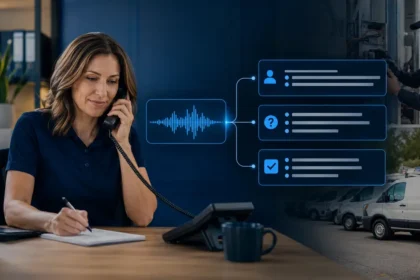


AI lead qualification helps contractors sort inquiries faster, but the workflow should be built around observable service and scheduling facts—not a mysterious prediction of who is “good.” The safest system checks whether the business can serve the request, identifies urgency, records customer preferences and routes the lead to an accountable next action.
- Quick answer
- Step 1: define a qualified lead
- Step 2: define disqualification and review
- Step 3: map lead sources
- Step 4: collect minimum information
- Step 5: validate identity, contact and geography
- Step 6: classify service intent
- Step 7: detect urgency responsibly
- Step 8: use explainable routing
- Step 9: add scoring only if it solves a queue problem
- Step 10: create the next action automatically
- Step 11: define service-level targets
- Step 12: test with historical and synthetic cases
- Step 13: launch in shadow mode
- Step 14: automate one route
- Step 15: measure business outcomes
- Step 16: create governance and change control
- Audit fairness and commercial assumptions
- A simple qualification worksheet
- Frequently asked questions
- Does AI qualification replace a salesperson?
- Should we automatically reject low-scoring leads?
- What is the best first qualification rule?
- Can AI prioritize by job value?
- How often should criteria be updated?
- What if sales and dispatch disagree?
- Related Oivic guides
- Authoritative resources
- Make qualification explainable
Quick answer
Define qualification criteria by service line, collect the minimum required fields, validate contact and territory, separate safety urgency from sales value, route with explainable rules, and require human review for uncertain or high-consequence decisions. Pilot the workflow in one channel, compare it with a baseline, and measure completed work rather than AI scores.
Step 1: define a qualified lead
Ask sales, dispatch and operations to write the conditions that make a lead actionable. Typical criteria include supported service, serviceable location, valid contact information, an identifiable next need and customer willingness to schedule or speak with someone.
Project businesses may add timing, property type, approximate scope and decision process. Repair businesses may need the reported symptom, access and urgency. Avoid criteria that merely describe the company’s favorite customer without affecting service delivery.
Step 2: define disqualification and review
Not every nonstandard lead should be rejected. Use three states:
- Qualified: meets documented criteria and can move to the standard next step.
- Needs review: potentially valuable but missing information or outside a standard rule.
- Not a fit: clearly unsupported service, territory or request.
A border ZIP, unusual commercial property or unclear service description belongs in review, not automatic rejection.
Step 3: map lead sources
Document website forms, chat, calls, email, ads, directories, referrals and partner channels. Identify the fields each source provides, where records arrive and who currently responds.
Create one normalized schema so “phone,” “mobile” and “callback number” do not become separate concepts. Preserve the original message and source attribution for context.
Step 4: collect minimum information
A practical core contains name, verified contact, service location, request, customer-reported symptoms, preferred timing and desired next step. Add questions only when they change routing or preparation.
Do not turn every channel into a long application. When information is missing, the workflow can create a task to confirm it rather than losing the lead.
Step 5: validate identity, contact and geography
Check phone and email format, address completeness and duplicate customers. Use the territory method trusted by dispatch. City names and ZIP codes alone can produce false decisions near boundaries.
Keep a provisional state for mapping errors, new developments and multi-location customers. Do not overwrite a verified customer record with an uncertain AI extraction.
Step 6: classify service intent
Map customer language to a supported category while retaining the original description. Use examples from real calls and forms. The classifier can identify “cooling problem” but should not infer a failed compressor.
When two categories are plausible, ask one clarifying question or route to review. Track confusion pairs and improve service names and examples.
Step 7: detect urgency responsibly
Create separate logic for safety triggers, operational urgency and sales priority. Safety language follows approved guidance and escalation. Operational urgency may reflect complete loss of an essential service. Sales priority may reflect project timing or a high-value request.
Store the reason, not only a red label or number. A dispatcher must understand why the lead moved to the top.
Step 8: use explainable routing
| Condition | Route | Required action |
|---|---|---|
| Supported routine repair in core area | Scheduling | Book supported visit or confirm request |
| Safety trigger | On-call lead | Immediate approved escalation |
| Large project or replacement | Assigned estimator | Review scope and schedule consultation |
| Existing-job complaint | Service manager | Review history before contact |
| Border location or unclear service | Review queue | Resolve missing fact before decision |
| Clearly unsupported request | Closed disposition | Provide honest response without invented referral |
Step 9: add scoring only if it solves a queue problem
A score may help when the company receives more valid leads than staff can immediately handle. Use transparent components such as service fit, urgency, timing, response readiness and completeness. Cap the influence of any one uncertain signal.
Do not infer income, protected characteristics or likelihood to pay from address, name, language or device. Human reviewers should see contributing factors and correct errors.
Step 10: create the next action automatically
Qualification is incomplete until a record has an owner and deadline. Create a booking, callback task, estimate review or escalation according to the result. Include the original message, structured fields, qualification reasons and unresolved questions.
Monitor whether the downstream system action succeeded. A classification sitting in an AI dashboard does not help the customer.
Step 11: define service-level targets
Set response times by lead type and coverage period. A safety alert differs from an after-hours estimate request. Targets must match staffing and include backup ownership.
Track overdue tasks and reassignment. Do not promise the customer a faster response than the office can deliver.
Step 12: test with historical and synthetic cases
Use recent leads whose outcomes are known, then add controlled edge cases. Include incomplete forms, noisy transcripts, misspellings, multiple services, border addresses, tenants, commercial properties, complaints and safety wording.
Create an answer key for qualification state, route, reason and action. Score false rejection, false acceptance, missed urgency and bad system action separately because their consequences differ.
Step 13: launch in shadow mode
Let the system classify leads without controlling the real workflow. Compare its result with staff decisions. Resolve whether differences reflect an AI error or an undocumented business rule.
Shadow mode reveals how inconsistent the current process may be. Standardize legitimate rules before automation.
Step 14: automate one route
Choose a high-volume, low-ambiguity path such as routine service requests in the core territory. Keep review for unusual and high-risk leads. Expand only after the automated route meets accuracy and response targets.
Step 15: measure business outcomes
- Time to first meaningful response
- Percentage of leads with complete required fields
- Qualified-lead precision and missed-fit leads
- Incorrect routing and manual correction time
- Appointments booked and completed
- Estimate conversion and completed-job gross profit
- Lead aging and overdue follow-up
Compare channels separately. A referral and a broad paid-search inquiry may have different close rates even when qualification is equally accurate.
Step 16: create governance and change control
Name an owner for criteria, sources, integrations, privacy and review. Record changes to service areas, pricing, hours, appointment types and routing. Rerun regression tests after material changes.
Review provider data retention, training use, access and deletion. Apply least privilege. Avoid placing payment data, credentials or unrelated sensitive information into general AI tools.
Audit fairness and commercial assumptions
Qualification should focus on the work the company can perform and the customer’s stated request. Review whether location, language, device, name or other proxies influence scores or response order without a legitimate operational reason. A geographic service boundary is different from assuming a household’s ability to pay.
Sample qualified, review and rejected leads. Look for groups of false rejection and require a documented reason for automated closure. Give employees a way to override the result and capture why. If a factor cannot be explained to the sales and operations team, remove it until it can be validated.
This review protects opportunities as well as customers. An opaque model may discard unusual but profitable work that an experienced employee would recognize.
Include frontline employees in the audit. Dispatchers and sales coordinators often notice patterns that summary dashboards hide, such as repeat corrections for rural addresses or project descriptions common in one community.
A simple qualification worksheet
| Field | Why needed | Allowed result | Owner |
|---|---|---|---|
| Service request | Determines capability and team | Supported, review, unsupported | Service manager |
| Location | Determines territory and travel | Core, border, outside | Dispatch |
| Urgency | Determines response path | Safety, operational, routine | Operations |
| Contact | Enables response | Verified or needs confirmation | Office lead |
| Next action | Moves the lead | Book, callback, review, close | Sales/dispatch |
Frequently asked questions
Does AI qualification replace a salesperson?
No. It can organize and route repeatable intake. People remain responsible for complex discovery, judgment, relationship and commitments.
Should we automatically reject low-scoring leads?
No. Use a review state, especially when information is incomplete. Automatic rejection can hide valuable edge cases and biased assumptions.
What is the best first qualification rule?
Service and territory fit are usually the clearest. Add urgency and scheduling readiness after those definitions are reliable.
Can AI prioritize by job value?
It can use documented project categories or stated scope, but estimates should be conservative and visible. Do not let speculative value override safety or existing commitments.
How often should criteria be updated?
Review routinely and after changes to services, territory, staffing, pricing, seasonality or capacity.
What if sales and dispatch disagree?
Resolve ownership and document the rule before automation. AI should not silently choose between conflicting operating policies.
Related Oivic guides
- Build a Lead-Qualifying Chatbot
- Score Leads by Urgency and Value
- AI Follow-Up Systems for Contractors
- Questions Your Chatbot Should Ask
Authoritative resources
- NIST AI Risk Management Framework
- NIST Generative AI Profile
- FTC guidance on AI privacy and confidentiality
Make qualification explainable
Oivic helps contractors connect lead intake, scheduling and follow-up with rules the team can understand and improve. Begin with service fit, territory and one accountable next action.