
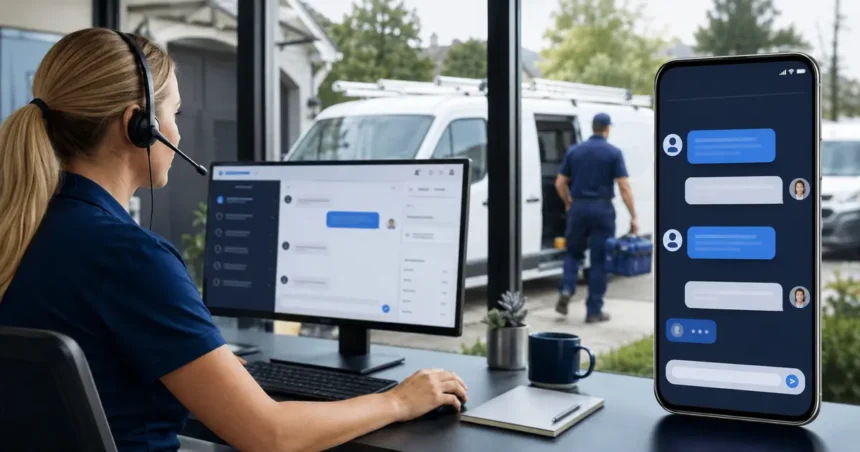
AI chatbots can be worth adding to a contractor website when they solve a specific visitor problem: getting a fast answer, checking service fit, requesting an appointment or reaching the right person. They are not automatically valuable because they keep a chat bubble online. A bot that gives vague answers, blocks contact details or invents availability can reduce conversions instead of improving them.
- Quick answer
- What a useful contractor chatbot should accomplish
- When a chatbot is likely to be worth it
- When another improvement should come first
- High-value chatbot use cases
- After-hours lead capture
- Service-area checking
- Basic qualification
- Routine customer information
- Human handoff
- Use cases that need limits
- Chatbot vs. form vs. live chat
- Calculate the business case
- Design a low-friction conversation
- Prepare the knowledge source
- Test before showing it to every visitor
- Track outcomes that matter
- Privacy and trust controls
- Common reasons chatbot pilots fail
- Success is defined as conversations
- The bot is launched site-wide immediately
- It asks too much before helping
- No one owns follow-up
- Knowledge is not maintained
- A 30-day pilot
- Frequently asked questions
- Will a chatbot improve contractor website conversion?
- How much website traffic is needed?
- Should the chatbot appear on every page?
- Can it provide estimates?
- Does chat replace the contact form?
- How often should answers be reviewed?
- Related Oivic guides
- Authoritative resources
- Give chat one measurable job
Quick answer
A contractor chatbot is worth testing when the website receives enough qualified traffic, visitors ask repeatable questions and the office can follow up quickly. Start with a narrow lead-capture and routing role. Use approved information, offer human contact, measure qualified appointments and completed-job value, and stop judging success by chat volume alone.
What a useful contractor chatbot should accomplish
The chatbot should help a visitor reach a better next step with less effort. That may mean confirming that the company serves a ZIP code, identifying the general service needed, collecting a few details after hours, or routing an existing customer to the right support channel.
Write one primary outcome for the pilot. Examples include “capture qualified after-hours water-heater leads” or “reduce office time answering service-area and appointment-preparation questions.” A bot told to answer everything will eventually answer something it should not.
When a chatbot is likely to be worth it
- The site receives a steady flow of relevant visitors.
- Many visitors leave without calling or submitting a form.
- The office repeatedly answers the same factual questions.
- After-hours visitors have strong purchase intent.
- Services, territories and intake rules are documented.
- Someone owns chat leads and can meet a response target.
The best case is not necessarily a large contractor. A small company with valuable jobs and missed after-hours inquiries may justify a controlled tool. Conversely, a high-traffic site with weak lead ownership can generate more neglected records.
When another improvement should come first
Fix the website before layering chat over basic conversion problems. Visitors should be able to see services, locations, proof, phone number and primary call to action without opening a widget. If the site is slow, confusing on mobile or attracts irrelevant traffic, chat will not solve the root issue.
A conventional form may be better when the request is simple and visitors prefer to complete it without conversation. Live chat may be better when questions are complex and the office has trained people ready. A callback option may be better for high-value projects requiring consultation.
High-value chatbot use cases
After-hours lead capture
Collect the visitor’s contact details, location, general need and preferred response time. Clearly state whether the company is closed and when follow-up should occur.
Service-area checking
Use approved address or ZIP logic, with a review option for border locations. Do not reject a lead from a city-name mismatch alone.
Basic qualification
Ask only questions that affect routing, safety or appointment type. The bot should not diagnose the issue.
Routine customer information
Answer verified questions about hours, appointment preparation, payment methods or how to request rescheduling. Account-specific answers require identity and access controls.
Human handoff
Collect context and transfer to live chat, phone or a callback queue. The visitor should not repeat everything.
Use cases that need limits
Do not let a general chatbot provide safety judgments, final prices for variable work, warranty decisions, refunds, technical diagnosis or guaranteed arrival times. For gas odor, smoke, electrical hazards, flooding near electricity and other approved triggers, show reviewed safety guidance and human or emergency options immediately.
Do not present generated project photos, reviews or credentials as real. If the bot cannot answer from an approved source, it should say so and offer a next step.
Chatbot vs. form vs. live chat
| Channel | Best for | Main limitation |
|---|---|---|
| AI chatbot | Repeatable questions and guided intake at any hour | Can misunderstand context or generate wrong information |
| Website form | Fast, predictable collection of known fields | Offers little clarification and may feel impersonal |
| Live chat | Complex questions, reassurance and flexible problem solving | Requires staffing, training and coverage |
| Phone | Urgent, emotional or nuanced conversations | Interruptive and dependent on answer capacity |
A strong website can offer more than one path. The chatbot should not cover the phone number or make the existing form difficult to reach.
Calculate the business case
Include subscription and usage fees, setup, integration, staff review, maintenance and correction time. Then estimate value from recovered qualified leads, faster response and reduced handling of repetitive questions.
Use completed-job gross profit rather than every dollar of quoted revenue. A simple pilot calculation is:
Net monthly value = incremental gross profit + verified staff capacity value − total chatbot cost.
Run conservative assumptions. If the tool only pays back when every chat becomes a large job, the case is not credible.
Design a low-friction conversation
Open with one useful question rather than a menu of everything the company does. Ask fields one at a time, acknowledge the visitor’s answer and explain why sensitive information is needed.
Do not demand an email before showing whether the business can help. For lead capture, a name, contact method, service location, brief need and preferred next step may be enough. Additional questions should have a clear operational purpose.
Make “talk to a person” visible. On mobile, ensure the widget does not block navigation, consent controls or the main call button.
Prepare the knowledge source
Provide concise, current information about services, exclusions, territory, hours, fees, financing language, appointment types, warranties and escalation. Assign owners and review dates. Do not use a crawl of the entire website as the only source if pages contain old promotions or broad marketing language.
Separate public answers from internal instructions. The chatbot may need to know that complaint leads go to a manager, but it should not reveal internal phone numbers or employee notes.
Test before showing it to every visitor
Create scenarios from search queries, form submissions and office call notes. Include misspellings, incomplete descriptions, several issues in one message, unsupported services, border towns, urgency, pricing, complaints and requests for a human.
Score factual accuracy, correct qualification, data capture, handoff success, action creation and customer effort. Verify the CRM record, email, task or appointment—not only the visible conversation.
Launch on selected pages or after hours first. A plumbing emergency page may need a different flow from a bathroom-remodeling page.
Track outcomes that matter
- Chat starts as a percentage of eligible visitors
- Qualified leads and valid appointment requests
- Human handoff completion
- Time from chat to first human response
- Incorrect-answer and correction rate
- Booked and completed jobs influenced by chat
- Gross profit compared with total cost
Compare chatbot pages and periods with a reasonable baseline. Watch overall website conversion, not just chat conversion. A widget can capture leads that would otherwise use the phone without increasing total results.
Privacy and trust controls
Tell visitors when they are interacting with automation in a clear manner appropriate to the experience. Publish or link to relevant privacy information. Avoid collecting payment card data, account credentials, government identifiers or unnecessary health and household details through a general bot.
Review provider retention, model-training use, subprocessors, access, deletion and security controls. The FTC has emphasized that AI companies must honor privacy and confidentiality commitments; contractors should also ensure that their own statements match practice.
Common reasons chatbot pilots fail
Success is defined as conversations
Activity does not show whether the company won suitable work.
The bot is launched site-wide immediately
Different pages have different intent. Begin where the workflow is strongest.
It asks too much before helping
Early contact gates and long questionnaires increase abandonment.
No one owns follow-up
A lead captured at night still needs a clear morning queue and response target.
Knowledge is not maintained
Old hours, territory or fees become confidently delivered misinformation.
A 30-day pilot
- Days 1–5: choose one page group and define the conversion outcome.
- Days 6–10: prepare approved answers, intake fields and escalation rules.
- Days 11–15: test normal, unusual and unsafe requests.
- Days 16–23: launch to limited traffic and review every lead.
- Days 24–30: compare qualified jobs, friction, errors and total cost with the baseline.
Frequently asked questions
Will a chatbot improve contractor website conversion?
It can when visitors need immediate guidance or after-hours intake. It can also shift leads from forms or phone without increasing total conversion, so measure the whole site.
How much website traffic is needed?
There is no universal threshold. Base the decision on qualified visitor volume, job value, current abandonment and the cost of running and supervising the tool.
Should the chatbot appear on every page?
Not initially. Start on pages with clear intent and a tested flow, then expand based on evidence.
Can it provide estimates?
It may share approved fixed fees or collect estimate information. Variable project prices should remain tied to inspection and qualified approval.
Does chat replace the contact form?
No. Keep a simple form, visible phone number and accessible human path. Visitors have different preferences and needs.
How often should answers be reviewed?
Review on a schedule and after any service, price, territory, hours, policy or platform change.
Related Oivic guides
- How to Build an AI Chatbot That Qualifies Leads
- AI Chatbot vs. Live Chat
- What Your Contractor Chatbot Should Ask
- Stop Your Chatbot From Giving Bad Information
Authoritative resources
- NIST Generative AI Profile
- FTC guidance on AI privacy and confidentiality
- FTC order concerning unsupported AI capability claims
Give chat one measurable job
Oivic helps contractors build connected lead systems instead of isolated website widgets. Start with one visitor intent, one follow-up owner and one completed-job metric.