
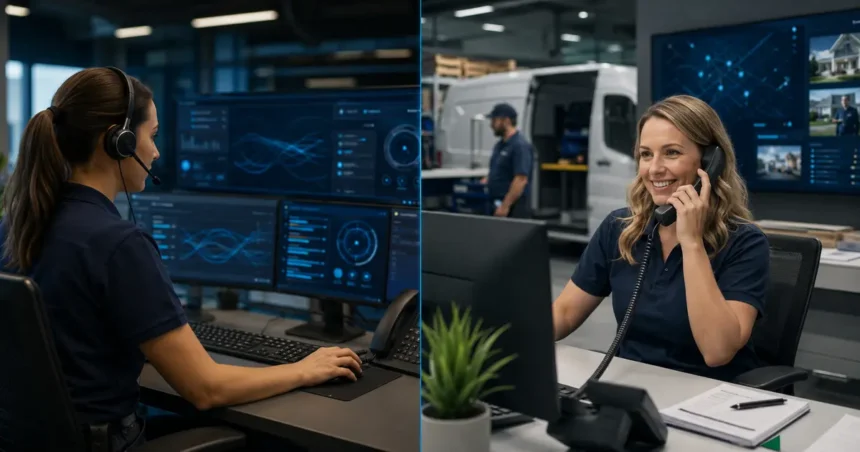
AI Receptionist vs. Answering Service: Which Is Better for Contractors? depends on the call, not the label. AI is generally strongest when the conversation follows known rules and needs immediate coverage. A human answering service is stronger when callers are emotional, requests are unusual or judgment matters.
- Quick answer
- The difference in plain language
- AI receptionist advantages
- Immediate and simultaneous response
- Consistent approved workflow
- Direct data capture
- Availability
- Scalable routine volume
- AI receptionist limitations
- Human answering-service advantages
- Human answering-service limitations
- Side-by-side decision table
- Match the solution to the call type
- Routine service request
- Emergency or safety concern
- Appointment rescheduling
- Complaint or warranty dispute
- Spam and vendor calls
- When hybrid coverage is the best answer
- Compare total cost, not the headline rate
- How to test both options fairly
- Questions to ask before signing
- Legal and trust considerations
- How the choice changes by contractor type
- Do not ignore the daytime office workflow
- Frequently asked questions
- Can we switch between AI and human answering by season?
- Who should own provider performance?
- Is an AI receptionist always cheaper?
- Which option books more jobs?
- Can I use AI only after hours?
- What if customers demand a human?
- Related Oivic guides
- Authoritative resources
- Choose by call type
Quick answer
Choose an AI receptionist for predictable intake, high availability, simultaneous calls and direct software workflows. Choose a human answering service for empathy, nuance and complex exception handling. Many contractors should use a hybrid: AI for routine after-hours or overflow calls, with clear transfer to trained people.
The difference in plain language
An AI receptionist uses software and generated voice or text to conduct a conversation, retrieve approved information and take configured actions. A traditional answering service uses human agents who follow scripts and account instructions.
Both can answer calls, take messages and route requests. Depending on the provider, either may book appointments or connect with business software. Do not assume every AI service is integrated or every human service provides deep judgment.
AI receptionist advantages
Immediate and simultaneous response
Software can usually handle multiple calls at the same time. This can help during storms, heat waves or marketing campaigns when callers would otherwise wait or reach voicemail.
Consistent approved workflow
When configured well, the system asks the required questions and follows the same routing logic. It does not forget a field because the queue is busy.
Direct data capture
A system connected to the CRM or field service platform may create requests, summaries and bookings without manual re-entry. Test field mapping and duplicate handling.
Availability
AI products are designed for nights, weekends and overflow. Availability is still dependent on the provider, phone routing and connected systems.
Scalable routine volume
For predictable calls, additional volume may not require recruiting and scheduling more agents. Check usage pricing and peak limits.
AI receptionist limitations
AI can misunderstand accents, interruptions, background noise and unusual descriptions. It may sound calm while taking the wrong action. It does not bring the lived judgment of an experienced dispatcher who recognizes that a caller’s “small leak” may require a different priority after one follow-up question.
Its knowledge is only as current as the approved source. Incorrect service areas, hours, prices or calendar rules become confident incorrect answers.
Human answering-service advantages
Nuance and empathy
A skilled person can respond to distress, hesitation and changing context more naturally. This matters in restoration, emergency plumbing, security and other stressful situations.
Flexible exception handling
Humans can ask unscripted questions, explain uncertainty and decide when instructions do not fit. The quality depends on training and access to account information.
Natural escalation
A human agent may recognize that the caller needs reassurance or immediate attention even when no exact keyword is used.
Complex conversation management
Warranty disputes, complaints, financing questions and multi-property requests may be easier for a trained person.
Human answering-service limitations
Performance can vary by agent, shift and workload. Shared agents may know little about the trade. Hold times and queue capacity can rise during regional events. Information may arrive as a message that office staff must re-enter.
Human service does not guarantee empathy or accuracy. Test the provider’s real agents, training, quality process and integration.
Side-by-side decision table
| Factor | AI receptionist | Human answering service |
|---|---|---|
| Routine intake | Strong with clear rules | Strong with training |
| Simultaneous volume | Typically strong | Depends on staffing |
| Emotional callers | Limited | Usually stronger |
| Unusual requests | Needs escalation | More flexible |
| Software entry | Potentially direct | Varies by provider |
| Consistency | Consistent configuration | May vary by agent |
| Maintenance | Knowledge and rules | Scripts and agent training |
Match the solution to the call type
Routine service request
AI may be a good fit when the system can verify location, service, urgency and appointment rules. Human service also works but may add manual handoff.
Emergency or safety concern
Use approved safety language and immediate transfer. A trained human path should be available. Neither provider should diagnose beyond authorized instructions.
Appointment rescheduling
AI works when it can securely identify the customer and access the correct calendar. A person is better when schedule changes affect several jobs or require negotiation.
Complaint or warranty dispute
Prefer a trained human. AI can capture information, but empathy, account context and authority are essential.
Spam and vendor calls
AI can filter predictable non-customer calls, while ensuring legitimate vendors and applicants have an appropriate route.
When hybrid coverage is the best answer
A hybrid model might use:
- Office employees during core hours
- AI after several rings and overnight for routine intake
- A human answering service for urgent categories
- An on-call employee for final emergency escalation
The handoffs must be tested. A complex arrangement that loses context between three providers can be worse than one simpler system.
Compare total cost, not the headline rate
AI may charge a platform add-on, usage or bundled plan. Human services may charge by minute, call, agent time or package. Include setup, overages, integrations, internal review and the cost of inaccurate bookings.
Calculate cost per qualified call and cost per accurate booking. Then compare incremental gross profit and customer experience. Cheap coverage that creates rework is not cheap.
How to test both options fairly
- Create the same call categories and desired outcomes.
- Provide the same approved company information.
- Run normal, incomplete and difficult test calls.
- Score accuracy, caller effort, empathy and correct routing.
- Pilot on comparable hours or call groups.
- Review recordings, messages and bookings.
- Compare total cost and staff correction time.
Questions to ask before signing
- Who or what answers each call?
- How are agents or AI trained on our business?
- What happens when the system is uncertain?
- How are emergency and complaint calls escalated?
- How are account updates tested?
- Which records and recordings are stored?
- How does pricing change at peak volume?
- Can we export conversation history?
Legal and trust considerations
Review disclosure, consent, recording, telemarketing and data requirements for the specific use. The FCC has confirmed that AI-generated voices fall within TCPA restrictions on artificial or prerecorded voices. State recording laws can also vary. Seek qualified advice.
Do not design the greeting to trick callers. A clear, helpful experience builds more trust than pretending software is a specific employee.
How the choice changes by contractor type
Emergency restoration: human judgment and escalation carry more weight because callers may be distressed and conditions can change quickly. AI can capture initial facts and reach the on-call team, but should not slow urgent transfer.
Recurring lawn or pest service: structured scheduling, service-area questions and routine account requests may fit AI well when customer identification and calendar rules are reliable.
High-ticket remodeling: call volume may be lower and conversations more consultative. A trained human service or direct staff callback may provide more value than broad automated booking.
Garage door or appliance repair: AI may capture model, symptom, location and preferred time, while safety-sensitive descriptions and uncertain duration require human review.
The trade name alone does not decide. Analyze actual call categories, urgency, average job value, schedule complexity and the office’s ability to follow up.
Do not ignore the daytime office workflow
Even perfect after-hours answering fails when the morning team cannot see priority, caller commitments or booking status. Compare how each provider delivers information. A direct CRM record may save work, while a human service may send a message that requires re-entry.
Assign a queue owner and response target. Measure callers successfully contacted after the handoff. This prevents both AI and human vendors from receiving credit for messages the contractor never acts on.
Frequently asked questions
Can we switch between AI and human answering by season?
Yes, when phone routing and contracts allow it. A contractor may need higher-capacity overflow during peak season and more human handling for slower, consultative months. Test every routing change and keep the customer record consistent.
Who should own provider performance?
An operations or office leader should own call outcomes, not the vendor alone. The owner reviews messages, bookings, transfers and morning follow-up and coordinates corrections with the provider.
Give that person authority to pause routing when quality falls.
Document every material routing change.
Review the outcome after peak demand periods.
Is an AI receptionist always cheaper?
No. Cost depends on platform requirements, usage, setup and review. A human service may be more economical for low volume, while AI may scale better for routine concurrent calls.
Which option books more jobs?
That depends on lead quality, response speed, conversation quality and booking rules. Test confirmed completed jobs, not only appointments created.
Can I use AI only after hours?
Yes. After-hours or overflow coverage is a sensible pilot because it targets calls that may otherwise reach voicemail.
What if customers demand a human?
Provide a direct transfer or prompt callback path. Record how often callers request it and whether transfers succeed.
Related Oivic guides
Authoritative resources
Choose by call type
Map your calls, then use Oivic’s buyer’s guide to run a controlled comparison.