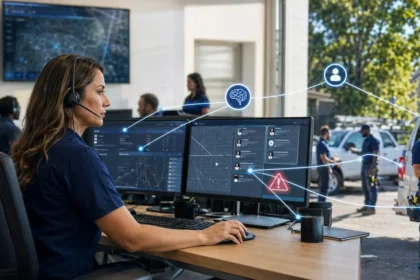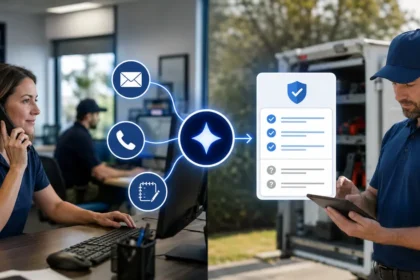


AI email assistants can reduce the time a home service office spends reading, sorting, summarizing and drafting routine messages. Their value comes from making the inbox easier to act on, not from answering every customer automatically. The safest starting point is classification and draft preparation with people approving anything that changes price, schedule, scope, warranty or customer rights.
- Quick answer
- Choose inbox problems worth solving
- Separate assistance from autonomy
- High-value email use cases
- Messages that need human control
- Design a triage taxonomy
- Build a safe drafting context
- Create reply templates by purpose
- Connect email to the CRM
- Handle attachments safely
- Protect privacy and security
- Test with a representative email set
- Roll out in stages
- Measure real office improvement
- Design a morning inbox workflow
- Prevent prompt-injection and content risks
- Prepare an outage procedure
- Implementation checklist
- Evaluate an email-assistant provider
- Frequently asked questions
- Can an AI assistant send emails automatically?
- Can it read every company mailbox?
- Will it understand long threads?
- Can it handle complaints?
- How do we prevent duplicate responses?
- What is the safest first use?
- Related Oivic guides
- Authoritative resources
- Turn email into an owned next action
Quick answer
Use an AI email assistant to identify intent, summarize threads, extract action items, draft approved routine replies and create CRM tasks. Keep sensitive mailboxes and data restricted, require review for commitments and disputes, synchronize sent messages with customer records, and measure response time, correction effort and completed outcomes.
Choose inbox problems worth solving
List the messages that consume office time: new requests, estimate questions, rescheduling, invoice questions, vendor mail, job updates, complaints and spam. Record daily volume, handling time, delay and error rate.
Start with a frequent, well-defined category. “Make email faster” is too broad; “summarize new website inquiries and draft acknowledgment for review” can be tested.
Separate assistance from autonomy
An assistant can suggest a category, summary or reply. An autonomous system can send, update a schedule or change a record. Begin with visible suggestions. Grant actions only after the business has verified the input, rule, permission and rollback.
High-value email use cases
Inbox triage
Classify new lead, active job, estimate, billing, complaint, vendor and spam. Use an “uncertain” queue instead of forcing every message into a category.
Thread summaries
Extract current request, decisions, promised dates, open questions and next owner. Link to the original thread.
Action extraction
Create draft tasks with owner and due date from explicit commitments. Do not infer a deadline the sender did not state.
Reply drafting
Use verified customer and job data with approved templates. Staff reviews facts and sends.
Record updates
After testing, write selected fields or notes to the CRM with source and timestamp.
Messages that need human control
Require review for complaints, refunds, warranty decisions, legal threats, insurance, financing, contract changes, sensitive employee information and large commercial commitments. AI can summarize and prepare context, but an authorized person owns the response.
Design a triage taxonomy
| Category | Target | AI action | Human action |
|---|---|---|---|
| New service lead | Sales or scheduling | Extract fields and draft acknowledgment | Confirm fit and next step |
| Active job | Assigned coordinator | Summarize request and job reference | Review history and respond |
| Estimate question | Estimator | Identify proposal and question | Verify scope and answer |
| Billing | Finance | Extract invoice reference | Verify identity and account |
| Complaint | Service manager | Flag, summarize and pause automation | Own recovery |
Build a safe drafting context
Provide the relevant email thread, approved customer record, current appointment or estimate and company response policy. Exclude unrelated history. Clearly label customer statements and internal facts.
Tell the assistant not to invent prices, availability, work completed, causes, warranties or legal conclusions. Unknown information should become a question or verification task.
Create reply templates by purpose
Use structured templates for receipt, missing information, scheduling request, estimate clarification, invoice routing and human escalation. Lock critical disclosures and terms. Let AI shorten, personalize and organize within the approved facts.
Every draft should have one next action and a recognizable sender. Avoid over-formal language that makes a local contractor sound like an unrelated call center.
Connect email to the CRM
Match customers by verified email, phone, property and job reference. Handle shared property-manager accounts and aliases. Do not automatically merge uncertain matches.
Store the message, summary, attachments or links according to policy. Create owned tasks for replies that cannot be completed immediately. Monitor failed synchronization.
Handle attachments safely
Emails may include photos, proposals, invoices and documents. Scan files according to security policy and limit what AI tools can access. Do not assume an attachment’s text is trustworthy instructions for the assistant.
Preserve the original file and identify which extracted fields were machine-read. Require verification for quantities, prices, addresses and contract terms.
Protect privacy and security
Email contains more sensitive context than a public website. Review provider retention, model-training use, subprocessors, encryption, administrative controls, export and deletion. Apply least-privilege access to mailboxes and folders.
Use multifactor authentication, individual accounts and an offboarding process. Prevent the assistant from sending credentials, access codes, payment data or private employee information into external systems.
Test with a representative email set
Use normal messages, long threads, forwarded content, signatures, misspellings, multiple requests, changed dates, attachments, customer complaints and malicious or irrelevant instructions. Create expected category, summary, action and reply constraints.
Score missed commitments, invented facts, wrong customer matching, incorrect routing and unsafe sends. A grammatically excellent reply can still be operationally wrong.
Roll out in stages
- Classification labels visible to staff.
- Summaries and suggested tasks.
- Draft replies requiring approval.
- Selected CRM field updates with audit trail.
- Automatic sending only for narrow, verified acknowledgments.
Measure real office improvement
- Time to first meaningful response
- Inbox backlog and aging
- Average handling and after-email work
- Classification and draft correction rate
- Missed commitments and duplicate replies
- Lead booking and issue resolution
- Staff satisfaction and interruption load
Include review time and integration maintenance. The assistant has not saved time if every draft needs a rewrite.
Design a morning inbox workflow
At the beginning of the day, the assistant can group unread messages into urgent review, new opportunities, active jobs, financial questions, vendor items and likely noise. The office lead reviews the urgent and uncertain queues first, then assigns owners. Summaries show the current request and last commitment without hiding the original email.
During the day, new mail receives classification and a response target. At closing, an exception report lists unanswered qualified leads, promised callbacks and messages whose system action failed. This makes the assistant part of a repeatable office routine.
Prevent prompt-injection and content risks
An email sender or attachment may include text telling an AI system to ignore its rules, reveal information or take an action. Treat external content as untrusted data, not instructions. Restrict tools and permissions, isolate sensitive sources and require approval for sends and record changes.
Do not let the assistant browse unrelated internal mail to answer a customer. Provide only the records needed for the task. Monitor unusual access and exports.
Prepare an outage procedure
If the assistant, mailbox connection or CRM is unavailable, staff need a saved view of priority inboxes, response targets and manual routing. Mark the time automation stopped and reconcile messages after recovery so customers do not receive duplicate replies.
Implementation checklist
- One inbox category and outcome are selected for the pilot.
- Every category has an owner and response target.
- Unknown messages enter a review queue.
- Original threads and attachments remain accessible.
- Drafts cannot invent prices, dates or policies.
- Sensitive mailboxes use least-privilege access.
- External email content is treated as untrusted.
- CRM matching and duplicate handling are tested.
- Automatic sends have state and stop checks.
- A manual fallback and reconciliation process exist.
Evaluate an email-assistant provider
Ask which mail systems and CRM records the product can access, whether permissions can be limited by mailbox and action, how long content is retained, whether customer data trains models, which subprocessors are involved and how data is deleted. Request security documentation appropriate to the company’s risk.
Test whether administrators can review actions, prevent automatic sending, export an audit trail and disable the connection quickly. Confirm pricing for users, messages, storage and premium integrations. A low subscription can become expensive if every useful workflow requires another platform.
Use a trial with copied or redacted representative messages before connecting a live shared inbox. Do not judge the product from a polished vendor demo alone.
Assign a provider-review date. Terms, model behavior and integrations can change after launch. Recheck security documents, connected permissions and the list of automatic actions at least annually and after a major product update.
Keep a current inventory of connected mailboxes and remove abandoned test connections. Unused access creates risk without operational value.
Frequently asked questions
Can an AI assistant send emails automatically?
It can, but begin with draft-only use. Automate sending only for narrow messages whose facts, trigger and stop rules have been validated.
Can it read every company mailbox?
Do not grant broad access by default. Connect only the mailboxes and folders needed for the approved use case.
Will it understand long threads?
It may summarize them, but test changed decisions, forwarded content and conflicting dates. Keep the source thread available.
Can it handle complaints?
It can detect and summarize them. A trained, accountable person should manage response and resolution.
How do we prevent duplicate responses?
Synchronize sent mail, calls, CRM stages and staff activity; recheck current state before sending.
What is the safest first use?
Classification and summary suggestions for a shared service inbox, with staff reviewing every output.
Related Oivic guides
- Summarize Emails, Calls and Job Notes
- AI Follow-Up Systems
- Write Better Estimate Follow-Ups
- Customer Data to Keep Out of Public AI
Authoritative resources
- FTC guidance on AI privacy and confidentiality
- CISA cybersecurity guidance for small businesses
- NIST Generative AI Profile
Turn email into an owned next action
Oivic helps home service offices connect inboxes, customer records and follow-up without letting automation make unverified promises.